

Jib Boom Attachment for Skid Steer: Uses and Buying Guide
Get the Attachment Your Project Needs
Shop proven, work-ready attachments that help you tackle any task with confidence.
LEARN MOREA skid steer can cover more of a job when it carries the right attachment on its quick-attach plate. A jib boom attachment for skid steer adds a dedicated lifting point for roof trusses, pipe, beams, bundled materials, and other loads that are difficult to handle with a bucket. The added reach is useful on compact jobsites where a larger crane may not maneuver easily. This guide explains what a jib boom does, how capacity changes with reach, how to plan a safe lift, and when renting or buying makes sense.
Shop jib boom attachments to compare models for your skid steer material-handling workflow.
What Does a Jib Boom Attachment for Skid Steer Do?
A jib boom attachment extends a skid steer's lifting point forward and upward. It lets the operator position suspended materials with approved rigging instead of pushing or dragging them with a bucket. Safe working load depends on the jib design, boom extension, load position, and the loader's rated operating capacity. The attachment and machine load charts control every lift.
The attachment mounts to the loader's quick-attach plate and creates a forward hook or lifting point. That geometry is useful when the load must clear a wall, reach into a truck bed, or rise to a set elevation. A jib boom can support controlled placement of roof trusses, structural members, pipe, lumber bundles, and farm supplies. It is a material-handling tool, not a replacement for a crane on heavy, high, or complex structural lifts.
Reach and capacity work against each other. A short extension keeps more of the load close to the machine and generally provides a more favorable lifting position. A longer extension reaches beyond obstacles but increases leverage against the loader and can reduce usable capacity. The operator must use the actual attachment chart and the skid steer operating limits rather than relying on a maximum rating shown in a product listing.
Common applications
Jib booms are most useful when the crew needs vertical placement, controlled reach, or a better line to the load. Typical applications include:
- Roof truss placement: Position trusses at elevation without pushing them with a bucket edge.
- Pipe and beam handling: Move long materials across a trench or into a prepared work area.
- Bundled material placement: Set lumber, supplies, or equipment where a pallet fork is not the best tool.
- Farm and landscape work: Handle feed, structural materials, and awkward loads in confined areas.
- Repeated short lifts: Add reach for routine work when a larger lifting machine would be impractical.
Choose a dedicated truss model when roof framing is the primary job. A fixed design can make a repeatable workflow straightforward. Choose an adjustable or telescoping model when load heights and reach change across jobs. eSkidSteer lists a dedicated skid steer truss jib attachment and an adjustable jib boom attachment for different material-handling needs.
How Much Weight Can a Jib Boom Attachment for Skid Steer Lift?
There is no universal lifting number for every skid steer jib. The practical limit is the lower applicable limit from the attachment rating, the loader's rated operating capacity, the load chart, and the planned load center. As the boom extends, the load sits farther from the machine. That leverage can reduce stability and allowable capacity even when the load itself does not change.
| Factor. | What changes. | Why it matters. |
|---|---|---|
| Boom extension. | Longer reach increases the distance from the loader. | Usable capacity can decrease at greater extension. |
| Load center. | The hook or load moves farther forward. | Leverage increases and stability can decrease. |
| Ground conditions. | Slope, softness, and uneven surfaces affect balance. | The machine may not remain stable at the rated limit. |
| Attachment design. | Fixed, adjustable, and telescoping jibs have different charts. | The design-specific rating controls the lift. |
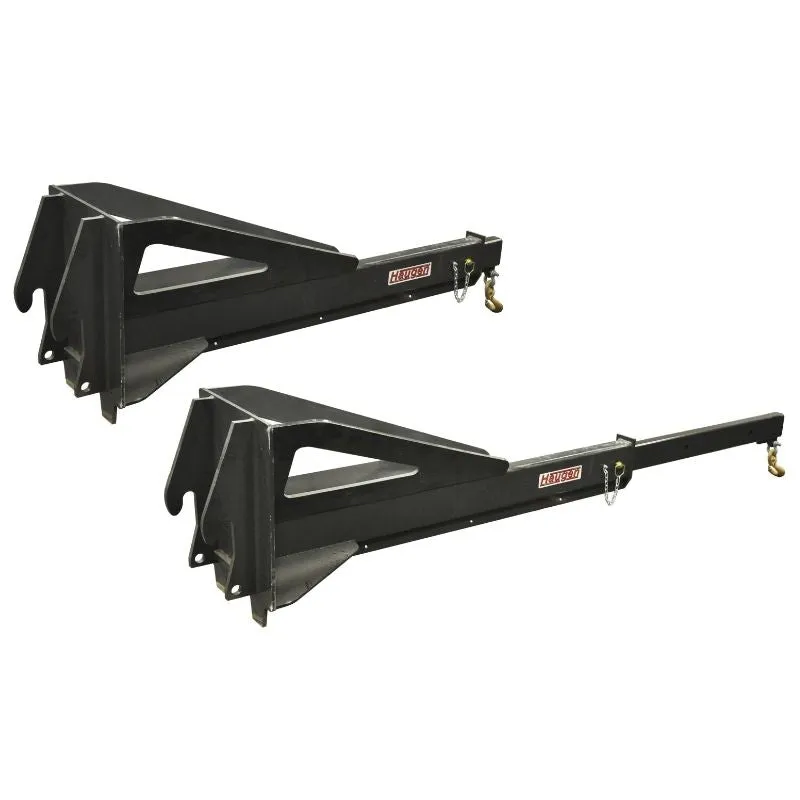
For example, the Haugen quick-attach adjustable jib product page identifies manual adjustment from 2 to 12 feet. It also lists eight locking positions and a rating of 2,000 pounds at 12 feet. Those are product-specific specifications, not a universal rating for every machine or load. Confirm the current product specification, then compare it with your loader's chart at the planned extension.
How to match the jib to your loader
Start with the load, not the advertised maximum. Record the load weight, dimensions, center of gravity, lifting points, required height, and distance from the machine. Then check the jib chart and loader manual for that exact configuration. Include the attachment weight in the loader's operating calculation. A jib that weighs hundreds of pounds reduces the remaining capacity available for the suspended load.
For shorter reach, an industrial adjustable jib for skid steers may suit a compact material-handling sequence. For roof work, compare the roof truss jib lifting attachment. If the job requires changing reach and pivoting, review the telescoping pivoting adjustable jib. The correct choice depends on the complete chart and the work you intend to perform.
How Do You Use a Jib Boom in a Safe Lifting Workflow?
A jib boom works best as one part of a documented lift plan. Before connecting the attachment, confirm the load, the path, the landing point, and the people responsible for signaling. Use only rigging that is rated and appropriate for the load. Inspect the mount, pins, locking mechanism, boom, hook, slings, and connection points before each shift.
- Confirm the configuration: Match the attachment and extension to the load chart and loader operating capacity.
- Inspect the equipment: Verify that the quick-attach mechanism, hardware, lifting point, and rigging are secure and undamaged.
- Prepare the site: Position the skid steer on firm, level ground with a clear travel path and a defined exclusion zone.
- Test the load: Raise it only a few inches to check balance, rigging, and machine response before traveling.
- Move under control: Keep the load low and centered, drive slowly, and avoid sudden turns, braking, or side slopes.
- Place the load: Lower it gradually at the landing point, then release the rigging only after the load is stable.
Use a trained spotter when the load or boom blocks the operator's view. Establish signals before the lift and stop immediately if communication is lost. Never allow anyone beneath a suspended load or between the boom and a fixed object. Keep the operator in the protected zone, use the seat belt and restraint system, and never bypass interlocks or safety devices.
Skid steer maneuverability helps in confined areas, but it does not remove struck-by, crush, or rollover hazards. Review the MSU skid steer safety guidance and the Virginia Tech skid steer safety publication. OSHA's rollover protective structure standard is another reference for applicable equipment requirements. For a related machine category, compare the material-handling principles in eSkidSteer's telehandler truss jib guide. Follow the machine and attachment manufacturers' instructions for the specific lift.
What Should You Look for When Choosing a Skid Steer Jib?
Start by defining the job that will occur most often. A truss-focused crew may value a dedicated design with a predictable setup. A contractor handling pipe, beams, supplies, and changing load heights may need an adjustable or telescoping arm. The best jib is the one whose reach, mounting, capacity, and operating procedure match the real work.
- Mounting system: Confirm the attachment uses the loader's compatible quick-attach interface.
- Reach range: Compare the shortest and longest positions with the height and distance required on the jobsite.
- Capacity chart: Check rated capacity at the exact extension and load center, not only the highest listed rating.
- Attachment weight: Include the jib itself in the loader's operating capacity calculation.
- Lifting hardware: Review the hook, lifting points, pins, pockets, and any included rigging interfaces.
- Operator visibility: Consider how the boom and suspended load affect sight lines and spotter requirements.
- Storage and inspection: Plan where the attachment will be stored and how the crew will inspect it before use.
Compare the Haugen quick-attach adjustable jib when flexibility is important. Its product information lists eight locking positions from 2 to 12 feet and a 5-ton Crosby swivel hook. Verify all current specifications before ordering and use the manufacturer's instructions for setup and operation.
Should You Rent or Buy a Skid Steer Jib Boom?
Renting can fit a one-time lift, a short project, or an evaluation period. It lets you match the attachment to a defined load without storing it long term. Before accepting a rental, confirm the attachment fits your loader and request the load chart for the planned reach. A rental decision should still include a test lift at low height and a review of site conditions.
Buying is more practical when the same lifting tasks recur. Ownership can make the tool available for repeated truss, pipe, or material placement, but the decision should include storage, inspections, operator training, and the attachment's weight. If job requirements vary, an adjustable model may provide more utility than a fixed design. If the work is almost always roof trusses, a dedicated truss jib may provide a simpler repeatable setup.
Compare expected use, rental frequency, transport coordination, storage, and the cost of downtime. Do not justify a purchase by capacity alone. A safe, compatible attachment that fits the crew's actual workflow is more valuable than a larger model that is difficult to configure or exceeds the loader's practical limits.
Browse skid steer attachments to compare jib boom options before you decide whether to rent or buy.
Frequently Asked Questions
What is a jib boom attachment used for on a skid steer?
A jib boom provides a forward lifting point for suspended materials that are awkward to handle with a bucket or forks. Common uses include positioning roof trusses, pipe, beams, lumber bundles, and other construction or farm materials. The boom adds reach while preserving the skid steer's compact maneuverability, subject to the attachment and loader capacity charts.
Can a jib attachment turn a skid steer into a mini crane?
A jib attachment gives a skid steer crane-like reach for controlled material positioning, but it does not make the loader a general-purpose crane. The operator must follow the attachment rating, loader load chart, rigging requirements, ground-condition limits, and site safety procedures. Heavy, high, or complex lifts may require different equipment.
How much weight can a skid steer jib boom lift?
Capacity varies by attachment design, extension, load center, and skid steer rated operating capacity. A longer extension generally reduces usable capacity because the load creates more leverage against the machine. Check the exact load chart for the attachment and loader combination before every lift, and include the attachment weight in the calculation.
What safety precautions are necessary when using a jib boom?
Inspect the quick-attach mount, boom, hook, pins, and rigging before use. Work on firm, level ground, test the load at low height, keep the load low during travel, and use a trained spotter when visibility is limited. Keep people outside the exclusion zone and never allow anyone beneath a suspended load.
Ready to Choose Your Jib Boom?
Find the right fit for your machine by shopping the skid steer attachments collection and comparing jib boom models for your next lift.