

How to Choose the Right Skid Steer Power Rake
Get the Attachment Your Project Needs
Shop proven, work-ready attachments that help you tackle any task with confidence.
LEARN MOREStandard grading tools struggle with rocky soil and heavy debris. A skid steer power rake breaks up compacted dirt, separates rocks from soil, and produces a smooth seedbed in a single pass. This attachment saves hours of manual labor on every job site and replaces the need for multiple grading tools.
A skid steer power rake (Harley rake) is a hydraulic grading attachment that uses a rotating drum with hardened teeth to pulverize soil, level surfaces, and windrow debris. Choose based on machine horsepower, working width, and hydraulic GPM flow.
Shop power rakes at eSkidSteer now
Matching the right power rake to your machine and job type requires understanding several factors. This guide covers every selection criterion so you can make a confident purchase. Start with a clear understanding of how these attachments work and what makes them effective for grading work.
What Is a Skid Steer Power Rake?
A skid steer power rake is a grading attachment designed for fine surface preparation, soil conditioning, and debris removal in a single operation. Many operators call it a Harley rake after the original brand name that popularized the rotating-drum design. The tool combines the functions of a grader, rock rake. And soil tiller into one attachment that mounts on the front of your skid steer or compact track loader.
How the rotating drum works
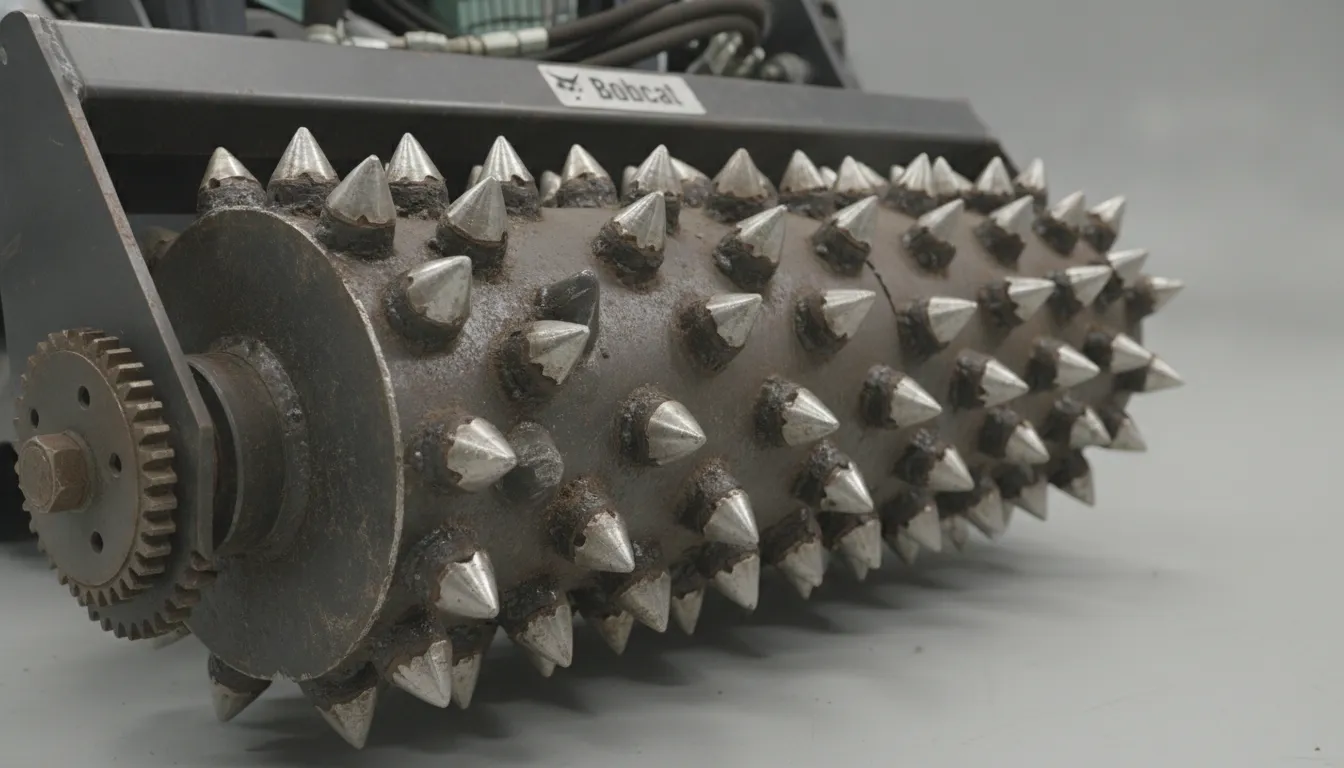
The core of the power rake is a hydraulic-driven drum fitted with hardened teeth that rotate at high speed. As the drum spins, the teeth break up soil clods, pull rocks and roots to the surface, and level high spots into low areas. The result is a fine, uniform soil tilth that is ready for seeding or sod installation. The drum can angle up to 20 degrees to the left or right. Which allows the operator to windrow debris to the side of the travel path for easy collection and removal later.
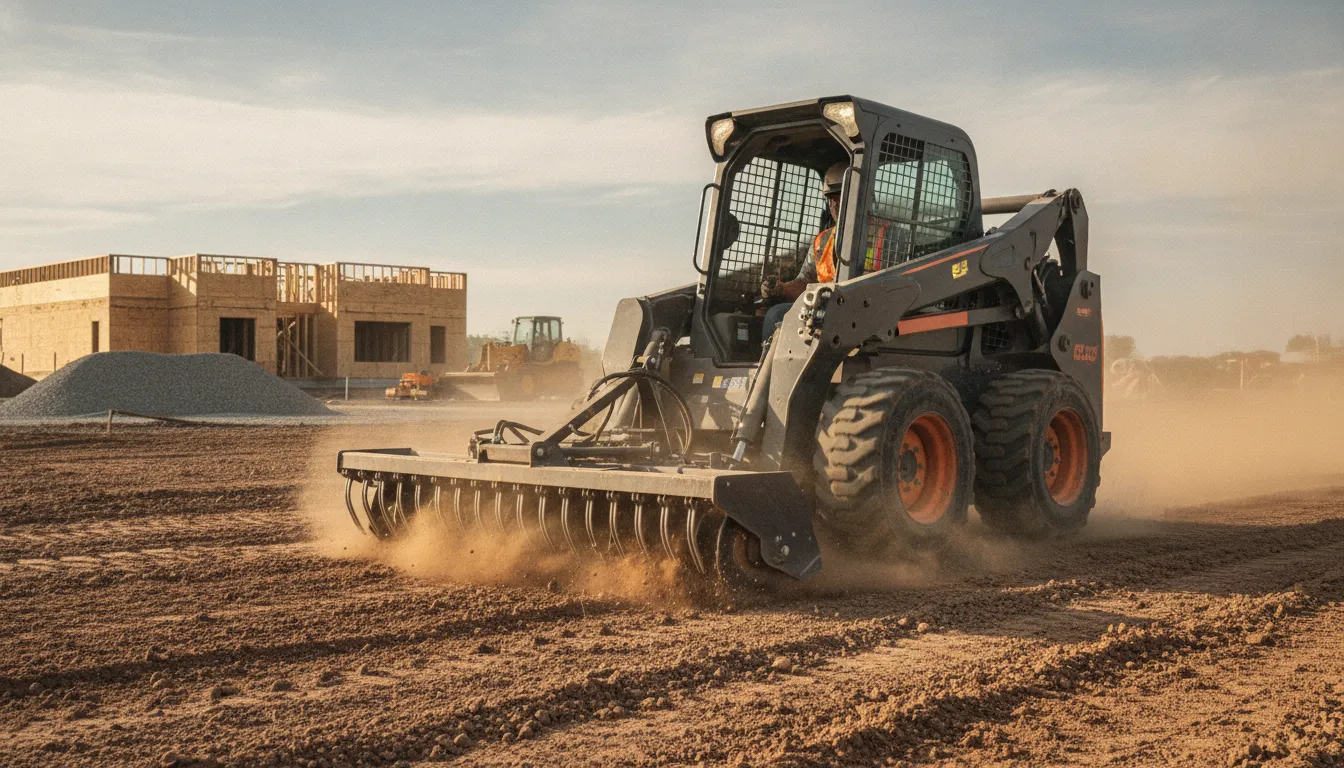
The angling capability is what makes the power rake unique among grading attachments. With the drum straight, the tool grades and levels the full width. With the drum angled, it pushes material sideways to create clean windrows. This dual-mode operation lets you switch between grading and debris collection without changing attachments, making the power rake more versatile than single-purpose tools.
Carbide tooth design and durability
The teeth on a power rake drum are engineered for longevity in abrasive soil conditions. Quality models use carbide-tipped teeth that resist wear and maintain their cutting edge across hundreds of hours of use. These teeth do more than just break up dirt: they cut through compacted high spots and redistribute material into low areas to create a consistent grade across the entire work area.
Adjustable gauge wheels mounted on each side of the drum control the depth of tooth penetration. These wheels prevent the rake from digging too deep into soft ground and help maintain a steady grade across uneven terrain. By setting the gauge wheels to the desired depth, you can repeat the same grade across consecutive passes without constant adjustment from the cab.
Why the Harley rake name stuck
The term Harley rake originated from an early manufacturer that dominated the power rake market. Over time the brand name became a generic descriptor for any power rake with a rotating drum design. Today manufacturers such as Blue Diamond, McLaren Industries, and Star Industries produce power rakes under their own brand names with significant improvements over the original design. You can compare current models from each brand in the power rake collection at eSkidSteer.
How Wide Should Your Power Rake Be?
Width is the first major decision when selecting a skid steer power rake. The right choice depends on your loader size, the types of projects you typically handle, and your operating environment. Choosing the correct width maximizes your productivity while keeping your machine within safe operating limits.
Standard width options by loader class
Power rakes are available in several standard widths designed to match different loader classes:
- 48 to 60 inches , Designed for compact skid steers, mini skid steers, and small track loaders. Best for residential landscaping, tight access areas, and gates. Easy to maneuver in confined spaces around homes and buildings.
- 72 inches , The most popular size for standard-sized skid steers. Balances coverage speed with maneuverability for most landscaping and grading jobs. A 72-inch rake fits the majority of mid-frame loaders on the market.
- 84 to 96 inches , Built for large-frame skid steers and open job sites. Maximizes per-pass coverage for commercial grading, agricultural field preparation, and large-scale development projects.
A practical rule of thumb is to choose a rake that is wider than your machine's tire or track width. This overlap lets you work right up to walls, curbs, and fence lines without leaving tire ruts in the prepared surface. The extra width also means you can cover track marks during the next pass, leaving a clean finish.
Weight and lift capacity considerations
Larger rakes are significantly heavier. An extreme-duty 96-inch model can weigh over 1,300 pounds, which directly affects your loader's lift capacity and tipping stability. Compact loaders under 50 horsepower should stay with standard-duty rakes in the 48-to-72-inch range. Mid-size and large-frame loaders with higher operating capacities can handle heavy-duty and extreme-duty models in wider sizes without stability concerns. Always check your loader's rated operating capacity against the attachment weight plus any additional downforce you plan to apply during grading.
Maneuverability in tight spaces
A wide rake covers more ground per pass but reduces turning capability in confined areas. If you regularly work on residential lots, around structures, or through gates, a 48 or 60 inch rake will serve you better. For open fields and large commercial sites, wider rakes let you finish faster. Many operators who do both types of work choose a 72-inch rake as a versatile compromise that handles most situations reasonably well.
What Hydraulic Flow Does a Power Rake Need?
Hydraulic flow, measured in gallons per minute (GPM), determines whether your machine can power the rake drum at the speed needed for effective grading. Using a rake that requires more flow than your machine delivers results in a stalled drum and poor soil processing. Matching flow rates is essential for proper operation.
Standard flow requirements for most rakes
The majority of power rakes operate on standard-flow hydraulic systems delivering 15 to 26 GPM. The Blue Diamond Extreme Duty power rake, for example, runs effectively in this range. If your machine outputs less than 15 GPM, the drum may stall or lose speed in thick, clay-heavy soil. Machines producing 10 to 14 GPM can still run smaller standard-duty rakes but will see reduced performance in tough conditions.
High flow systems for heavy-duty work
High-flow hydraulic systems producing 30 GPM or more can drive heavy rakes through the toughest ground conditions. These systems maintain full drum speed in rocky or compacted soil where standard flow machines would struggle to keep the drum turning. Check your loader's technical specifications in the operator manual to confirm your exact GPM rating before selecting a rake. Running a high-flow motor on a standard-flow system will not damage the motor but will produce noticeably slower drum rotation and less effective soil breakdown.
Motor protection and maintenance
The hydraulic motor is the most expensive component on a power rake and requires protection from impact and contamination. Quality designs position the motor inside the drum housing to shield it from rocks and debris. CID motors are rated for 16 to 26 GPM and built with protective housings for extended service life. Monitor your system pressure regularly and inspect hydraulic hoses for leaks or chafing before each use to prevent motor damage and costly repairs.
Key Power Rake Features: What to Look For
Beyond width and hydraulic flow, several design features distinguish a high-performing power rake from an average one. These details affect how well the tool performs across different job site conditions and how long it lasts before needing repairs.
Angle control and debris management
The ability to angle the drum is essential for effective windrowing during grading. Look for models offering at least 15 to 20 degrees of angle adjustment in either direction. Hydraulic angle control lets you change the drum direction from the cab without stopping the machine, which is valuable on large commercial sites. Adjustable side shields help contain material within the drum path or direct it into windrows depending on the shield position. Giving you additional control over how material is handled during grading.
Comparison: standard duty vs extreme duty features
| Feature | Standard Duty | Extreme Duty |
|---|---|---|
| Working widths | 48 to 72 inches | 72 to 96 inches |
| Angle control | Manual pin adjustment | Hydraulic, 5 positions |
| Tooth material | Fixed steel tines | Replaceable carbide |
| Hydraulic requirement | 10 to 15 GPM | 15 to 26 GPM |
| Frame construction | C-channel steel | 4x4 heavy square tubing |
| Typical weight | 400 to 700 lbs | 800 to 1,366 lbs |
| Recommended use | Light residential | Daily commercial |
Frame strength and tire selection
A rigid frame prevents flex under heavy grading pressure, which ensures consistent tooth depth across the full width of the drum. Models built with 4x4 square tubing offer superior stiffness for deep soil engagement without frame twisting. Airless tires on the gauge wheels eliminate flat tires on rough job sites with sharp debris and maintain consistent depth control over uneven terrain. Pneumatic tires provide a smoother ride on finished surfaces but are more prone to punctures in rocky conditions.
Power Rake Duty Ratings and Brand Options at eSkidSteer
Power rakes are categorized by duty rating, which reflects their construction strength and intended workload. Matching the rating to the intensity of your work prevents premature wear and ensures reliable performance over the life of the attachment.
Standard, heavy, and extreme duty explained
Standard-duty rakes work well for light landscaping, lawn renovation, and occasional residential use. They are lighter, require less hydraulic flow, and cost less to purchase. Heavy-duty and extreme-duty models use thicker steel frames, larger diameter drums, and more robust hydraulic motors with protective housings. These are designed for daily commercial operation, site preparation, and rocky soil conditions. A contractor who uses a power rake every week will benefit from the extended durability of a higher rating. While a homeowner who uses it a few times per year may find a standard-duty model sufficient.
Top brands available at eSkidSteer
eSkidSteer stocks power rakes from three leading manufacturers, each with distinct design strengths:
- Blue Diamond , Offers Heavy Duty Series 2 and Severe Duty Series 3 models. The Blue Diamond extreme duty power rake features a 4x4 tubular frame, carbide replaceable teeth, and hydraulic angle control for professional-grade performance. Blue Diamond is widely regarded as a top-tier brand for demanding commercial applications.
- Star Industries , Known for the motor-in-drum design that protects the hydraulic motor from impact damage caused by rocks and buried debris. View the Star Industries skid steer power rake for a rugged option with replaceable carbide teeth and heavy-duty construction.
- McLaren Industries , Builds high-grade hydraulic power rakes with smooth operation and reliable hydraulic systems. McLaren rakes are known for consistent drum speed and even soil processing across the full working width.
Skid Steer Power Rake vs Other Grading Attachments
Understanding how a power rake compares to alternative grading tools helps you choose the right attachment for each phase of a project. Each tool has a specific role in the grading sequence, and using the right one for each stage improves efficiency.
When a power rake is the right choice
A power rake excels at final soil preparation. It pulverizes soil clods into fine particles, removes small rocks and roots from the surface layer, and leaves a level seedbed in a single pass. Use it when the goal is a finished surface ready for grass seed, sod, or landscaping material. The power rake produces the finest soil texture of any grading attachment, which makes it ideal for applications where seed-to-soil contact is critical for germination.
Power rake vs box blade vs rock rake
| Feature | Power Rake | Box Blade | Rock Rake |
|---|---|---|---|
| Primary use | Seedbed and finish grading | Heavy cutting and filling | Rock and debris removal |
| Soil texture result | Fine tilth | Rough grade | Medium |
| Debris handling | Small rocks and roots | None | Large rocks and roots |
| Best application | Landscaping and lawn prep | Ditch work and grading | Land clearing |
| Typical pass speed | Moderate | Fast | Slow |
Landscape rakes for surface-level cleaning
A landscape rake uses tines that drag across the soil surface to collect light debris like grass clumps and small sticks. It does not pulverize soil or level the ground. For rough cleaning before final grading begins, a landscape rake works fine. However, for the finished seedbed that power rakes produce, the landscape rake cannot match the results. The Rockaway skid steer rock rake is a strong option when your site has significant rock content that needs removal before the power rake performs final grading. Using a rock rake first, then following with a power rake, produces the best results on sites with heavy rock concentrations.
Compare power rake models and pricing at eSkidSteer
Frequently Asked Questions
What does a skid steer power rake do?
A skid steer power rake spins a drum lined with hardened teeth to break up soil, separate rocks from dirt, and level the ground in a single operation. It prepares a smooth, fine seedbed ready for seeding, sod installation, or landscaping material placement.
What size power rake fits my skid steer?
Choose a width that exceeds your machine's tire or track width so you can work up to edges without leaving marks. For a standard mid-frame skid steer, a 72-inch power rake is the most common choice. Compact loaders should use 48 to 60 inch rakes for proper weight and lift capacity matching. Large-frame loaders can run 84 to 96 inch models for maximum coverage.
Do I need high-flow hydraulics for a power rake?
Most standard power rakes operate on 15 to 26 GPM, which matches standard-flow hydraulic systems found on typical skid steers. High-flow machines provide extra power for tough soil conditions but are not required for normal landscaping and grading use. Check your machine's GPM rating before purchasing.
Is a power rake worth the investment?
A power rake combines grading, rock removal, and soil leveling into one pass, which reduces labor time compared to using separate attachments or manual methods. For contractors and landscapers who prepare soil regularly, the time savings quickly justify the investment. The attachment also reduces the need for additional grading tools in your fleet.
What brands of power rakes does eSkidSteer carry?
eSkidSteer offers power rakes from Blue Diamond, Star Industries, and McLaren Industries. Each brand offers multiple duty ratings to match different machine sizes and project intensities. Browse the full power rake collection to compare specs, features, and pricing side by side.
Ready to Find the Right Power Rake?
Choosing the correct width, hydraulic match. And duty rating ensures your power rake delivers efficient results on every job site. eSkidSteer carries a full lineup of power rakes from Blue Diamond. Star Industries, and McLaren Industries, with sizes from 48 to 96 inches and duty ratings from standard to extreme. Every model ships fast with easy online ordering and competitive pricing on all attachments.