


Telehandler Grapple Attachment Selection Guide
Get the Attachment Your Project Needs
Shop proven, work-ready attachments that help you tackle any task with confidence.
LEARN MOREA telehandler grapple attachment turns a telehandler into a controlled material handler for brush, logs, demolition debris, and other awkward loads. The right grapple must match the material, carriage, auxiliary hydraulics, attachment weight, and machine load chart. Selection is not simply a question of buying the widest or heaviest model.
Browse telehandler grapple attachments and compare the available designs for your work.
The best buying decision starts with the job, then works backward through the machine specifications. This guide explains the details that matter before purchase and the operating checks that matter once the grapple reaches the site.
What does a telehandler grapple attachment do?
A telehandler grapple attachment uses one or more hydraulic clamps to hold material against a bucket, tine frame, or purpose-built lower jaw. Unlike forks or a standard bucket, the grapple applies downward holding force. That extra control is useful when a load is bulky, irregular, or likely to shift during travel.
The grapple does not increase the telehandler's rated lifting capacity. In fact, its own weight and forward projection reduce the capacity available for material. The advantage is better load retention and handling control when the attachment is correctly matched to the machine and task.
Where a grapple adds value
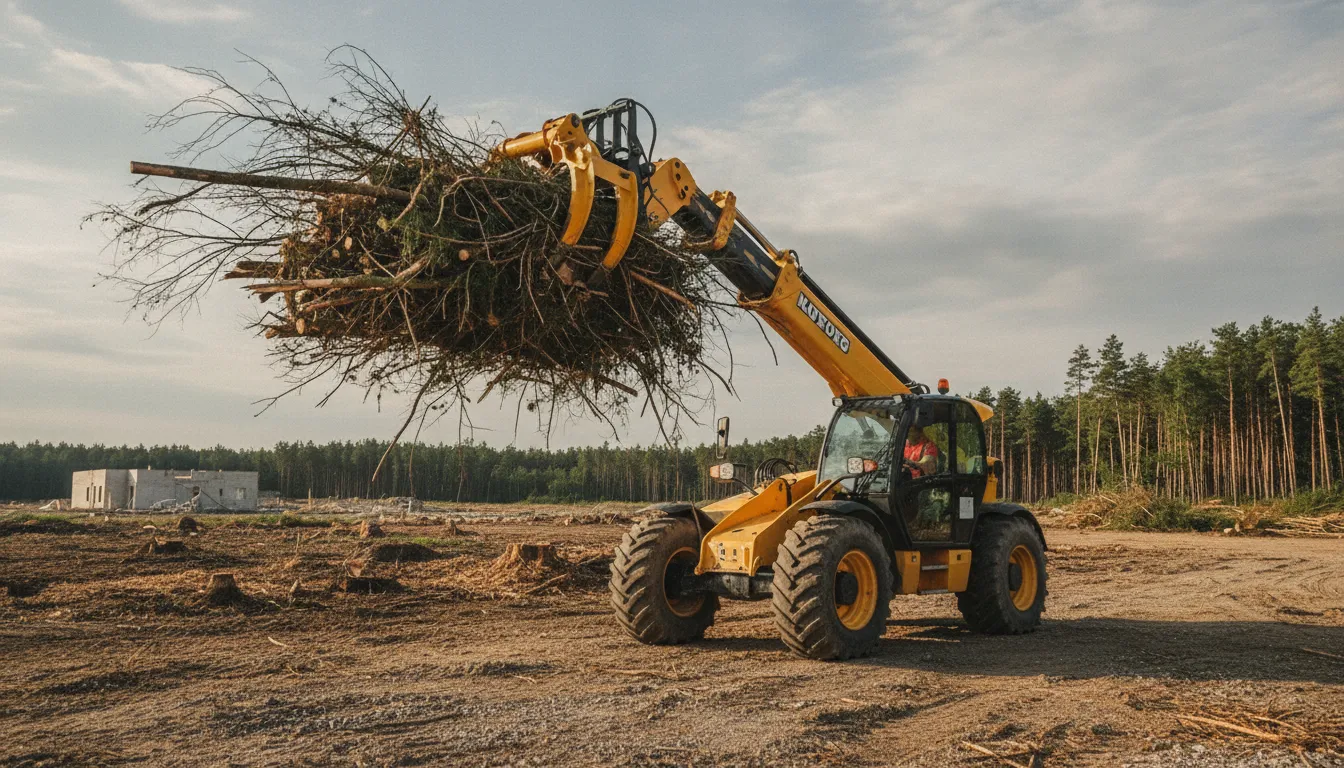
- Land clearing: Clamp brush, limbs, roots, and storm debris while allowing loose soil to remain behind.
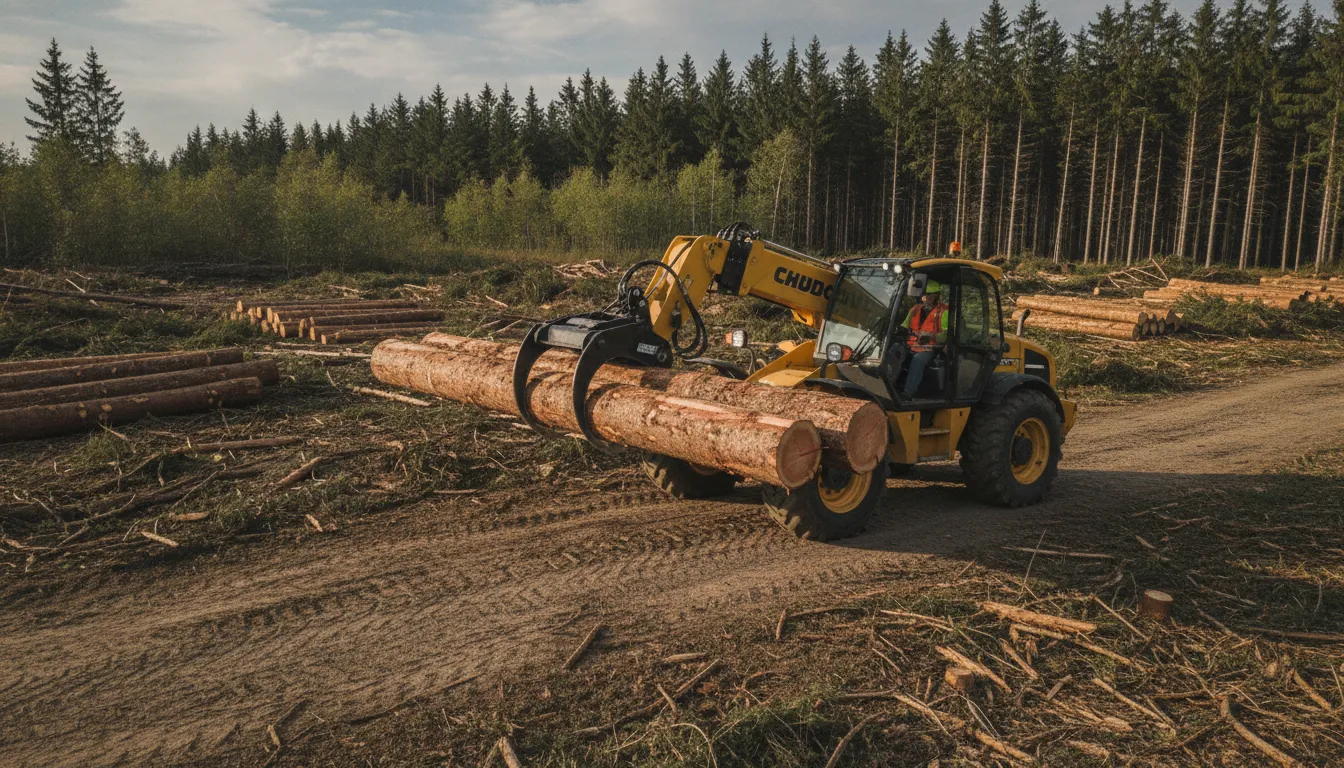
- Log handling: Hold round or uneven timber more securely than an open bucket or bare forks.
- Site cleanup: Contain mixed construction debris that would otherwise spill from a standard bucket.
- Material sorting: Pick, separate, and place bulky items with more control than a non-clamping attachment.
Buyers comparing a grapple with other tools can review the broader telehandler attachments guide. It explains how buckets, forks, and other attachment types change the work a telehandler can perform.
Match the grapple design to the material
Choose the lower frame and clamp geometry around the material handled most often. A solid-bottom grapple bucket retains small debris, while an open-tine root grapple lets soil fall through. A log-oriented grapple uses curved contact points to control round loads. Each design trades versatility for performance in a specific application.
| Grapple design | Best suited to | Key advantage | Main limitation |
|---|---|---|---|
| Solid-bottom grapple bucket | Loose debris, mulch, mixed cleanup | Retains smaller material | Carries more attachment weight and soil |
| Open-tine root grapple | Brush, roots, limbs, land clearing | Sifts loose soil from the load | Does not retain fine material |
| Log or pipe grapple | Logs, poles, and other round loads | Curved geometry controls rolling | Less versatile for loose debris |
Look beyond the product name
Two attachments labeled as brush grapples may behave differently. Compare tine spacing, clamp shape, jaw opening, overall width, and the number of independently moving clamp sections. A divided clamp can conform better to uneven loads because one side can close farther than the other. A single full-width clamp may be simpler but less adaptable across an irregular pile.
For mixed work, identify the most demanding recurring material rather than the easiest job. An attachment that controls the difficult load usually handles simpler tasks too. If most work involves fine debris, however, an open-bottom design may create extra cleanup and repeated trips.
How do capacity, width, and geometry affect selection?
Attachment weight, load-center distance, boom extension, and lift height all affect usable capacity. Opening width determines the largest pile the grapple can accept, but it does not determine how much the telehandler can safely lift. Always use the machine manufacturer's load chart for the exact machine and approved attachment configuration.
Start with the load chart, not the grapple rating
A grapple may be structurally rated for more than the telehandler can lift at a given reach. The telehandler's capacity commonly decreases as the boom extends or rises. Attachment weight also consumes part of the available capacity before any material is picked up. Compare the combined weight of the attachment and expected load with the applicable load chart.
Attachments can change capacity, stability, and safe operation. The OSHA powered industrial truck attachment guidance explains that attachments affect a truck's capacity and safe operating characteristics. Follow the telehandler and attachment manufacturers' instructions rather than relying on a general rule of thumb.
Measure the material envelope
Jaw opening should accommodate the normal load without forcing the operator to overfill or make an unstable grab. Overall attachment width affects maneuverability, visibility, and the amount gathered per pass. Tine length and spacing influence both penetration and material retention. Wider tine spacing sheds soil faster, while closer spacing holds smaller debris.
- Expected load weight: Use realistic maximum loads, not an average that ignores the heaviest routine pick.
- Attachment operating weight: Include the complete grapple, mounting hardware, hoses, and any adapter.
- Load position: Consider how far the load's center sits in front of the carriage.
- Required reach and height: Check capacity at the boom positions the job actually requires.
Verify carriage fit and auxiliary hydraulics
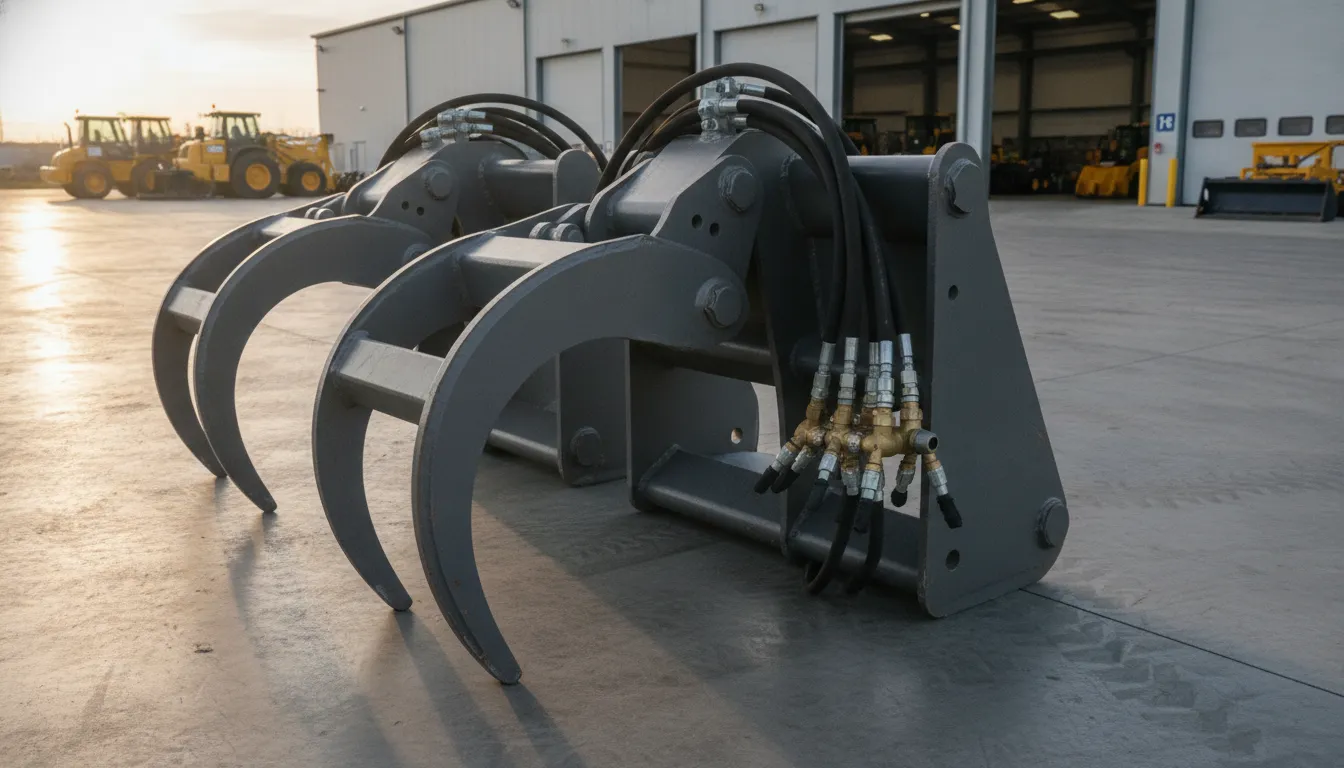
A telehandler grapple must physically lock to the carriage and connect to a compatible auxiliary hydraulic circuit. Confirm the carriage or quick-attach interface, hydraulic flow and pressure requirements, coupler type, and hose routing before ordering. Similar-looking mounts are not proof of compatibility.
Confirm the complete mounting interface
Record the telehandler make, model, year, carriage type, and any existing adapter. Compare those details with the attachment supplier's fit information. Check locking-pin engagement, carriage width, hook or plate geometry, and clearance through the attachment's full range of motion. An adapter adds weight and can move the load farther forward, so include it in capacity calculations.
Some buyers consider using skid steer attachments on a telehandler. The skid steer attachment and telehandler compatibility guide covers the fit, hydraulic, and capacity questions that must be resolved before doing so.
Match flow, pressure, couplers, and routing
Hydraulic pressure produces clamping force, while flow influences how quickly the jaw opens and closes. The grapple's required operating range must match the telehandler's auxiliary circuit. Couplers must also match in size and type. Do not assume that replacing couplers solves an underlying flow or pressure mismatch.
Inspect the intended hose route with the attachment rolled forward, rolled back, raised, and lowered. Hoses need enough length for movement without hanging where they can snag. They must also avoid pinch points, sharp bends, hot surfaces, and contact with the load.
How to choose a telehandler grapple attachment
Choose a telehandler grapple attachment by documenting the material first, then confirming machine fit and operating limits. A disciplined selection process prevents a common buying mistake: finding a grapple that looks suitable for the load but does not match the carriage, hydraulics, or load chart.
- Define the primary material. Record its shape, size range, density, and whether fine material must be retained or sifted.
- Estimate the heaviest routine load. Include wet or contaminated material when that condition is realistic.
- Choose the grapple style. Compare solid-bottom, open-tine, and purpose-built round-material designs.
- Confirm the carriage interface. Match the complete mounting geometry, not just the general coupler name.
- Verify auxiliary hydraulics. Match flow, pressure, coupler type, and hose routing to the attachment requirements.
- Check the applicable load chart. Account for attachment weight, any adapter, load center, boom height, and reach.
- Review wear and service points. Inspect tine construction, protected hydraulic components, pins, bushings, and grease access.
Ask for specifications that support the decision
Useful attachment specifications include operating weight, overall width, maximum jaw opening, tine spacing. Mounting interface, hydraulic flow range, maximum operating pressure, hose and coupler details, and any rated capacity. Compare those figures with the telehandler manual and the work profile. If a required compatibility detail is unclear, confirm it before purchase.
Compare telehandler grapples after recording your machine and job requirements.
Safe operating practices for grapple work
Safe grapple operation starts with the correct load chart, trained operators, a secure attachment connection, and a pre-use inspection. Keep loads controlled and as low as practical during travel. Never use clamp force as a substitute for correct load positioning, and never exceed the limits of the machine or attachment.
Inspect before each shift
- Mount and lock: Confirm the attachment is fully seated and every locking device is engaged.
- Hydraulic system: Check hoses, fittings, couplers, cylinders, and guards for leaks or damage.
- Structure: Look for bent tines, cracked welds, damaged clamps, and abnormal pin or bushing movement.
- Function: Cycle the grapple in a clear area and verify smooth, controlled movement.
- Documentation: Make sure the operator has the correct load chart and knows the attachment's limits.
Control the load throughout the move
Center the load in the grapple and close the clamp only enough to secure it. Excess clamping force can damage material or the attachment. Before traveling, make a low test lift to confirm the load is stable and the grapple maintains control. Keep people clear of the load and follow the telehandler manufacturer's travel and terrain instructions.
The boom position that works for picking may not be appropriate for travel. Avoid sudden steering, braking, or boom movements that can shift the load. Reassess the pick if visibility is blocked or the material cannot be held securely. For a broader view of available tools, visit the telehandler attachment collection.
Plan for inspection, wear, and service
A grapple works in abrasive, impact-heavy conditions. Serviceability matters because worn pins, damaged hoses, and bent contact points reduce control. Before buying, look at how easily an operator can inspect the mount, cylinders, hoses, clamp pivots, pins, bushings, cutting edges, and tines.
Grease points should be accessible with the attachment safely positioned. Hydraulic cylinders and hoses benefit from guards, but those guards must still allow inspection. Replaceable wear components can reduce long-term downtime when the grapple regularly contacts soil, scrap, or demolition debris.
Use job-specific inspection intervals
The manufacturer's schedule is the baseline. Conditions may justify more frequent checks, especially when the grapple handles abrasive soil, sharp scrap, or repeated shock loads. Record defects and remove an unsafe attachment from service until it is repaired according to the manufacturer's instructions.
A well-matched grapple should improve control without creating avoidable compatibility or service problems. Buyers ready to compare models can review eSkidSteer's telehandler grapple attachment collection.
Frequently asked questions
What is the best telehandler grapple for brush?
An open-tine root or brush grapple is often suited to brush because it holds limbs while allowing loose soil to fall through. The right model still depends on carriage fit, hydraulic requirements, attachment weight, jaw opening, and the telehandler's applicable load chart.
Will any grapple attachment fit a telehandler?
No. Mounting interfaces, carriage geometry, auxiliary hydraulic requirements, couplers, and capacity limits vary. Confirm the telehandler make and model, carriage type, hydraulic specifications, attachment weight, and load-chart requirements before purchase.
Does a grapple reduce telehandler lifting capacity?
The grapple's own weight and load-center position affect the capacity available for material. Capacity also changes with boom height and reach. Use the machine manufacturer's load chart for the specific machine and approved attachment configuration.
What should be checked before operating a telehandler grapple?
Confirm the mount is locked, inspect the grapple structure and hydraulic components, verify hose routing, cycle the attachment in a clear area, and review the correct load chart. Operators must be trained for the machine and attachment.
Find the right telehandler grapple for your work
The best grapple is the one that fits the machine, controls the material, and stays within the applicable operating limits. Document the job, carriage, hydraulics, and load-chart requirements before comparing models. That preparation makes it easier to narrow the options without guessing about compatibility.
Browse eSkidSteer's telehandler grapples to compare available attachments for brush, logs, debris, and material-handling work.