


T-Post Driver Attachment for Skid Steer: Complete Guide
Get the Attachment Your Project Needs
Shop proven, work-ready attachments that help you tackle any task with confidence.
LEARN MOREDriving a long run of steel fence posts by hand can turn a productive fencing job into a repetitive positioning and striking task. A skid steer-mounted hydraulic driver uses the machine's quick-attach interface and auxiliary hydraulics to deliver consistent impact while the operator controls alignment from the cab.
Browse eSkidSteer's skid steer post drivers to compare t-post driver attachment options built for quick-attach install.
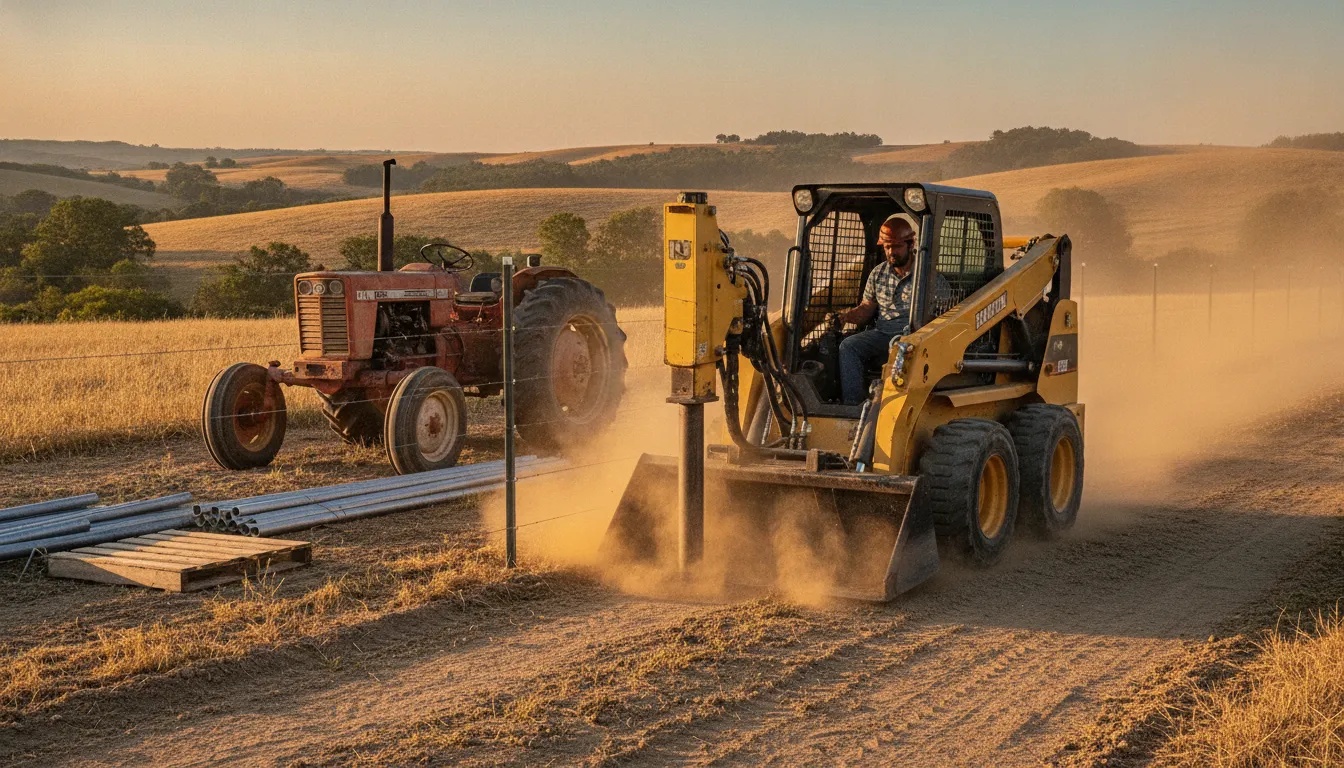
A t-post driver attachment for skid steer is useful when you need to install multiple steel T-posts efficiently and with repeatable depth. Before choosing one, match its mounting plate, hydraulic flow and pressure requirements, post-size range, and operating clearance to your skid steer and fencing application. Typical hydraulic drivers may deliver several impact strokes per second, but actual performance depends on the attachment and machine combination.
The right setup still requires careful positioning, vertical alignment, and a defined stopping depth. Understanding how the driver transfers hydraulic power into impact force makes it easier to evaluate attachment designs and select equipment that fits the work ahead.
What Is a T-Post Driver Attachment for Skid Steer
A t-post driver attachment for skid steer is a hydraulically powered hammer that mounts to the machine's front quick-attach system and drives steel fence posts into prepared ground. Instead of relying on repeated manual strikes, the attachment uses hydraulic power to deliver controlled impacts through a post guide or driver head. The skid steer supplies the lift, positioning, and hydraulic flow needed to place posts efficiently across a fence line, pasture, construction site, or landscaping project.
The basic operating concept is straightforward. The operator positions the attachment over a post, places the post in the driver head. And lowers the quick-attach-mounted tool until it is aligned with the desired driving point. The hammer then transfers force to the top of the t-post or small pipe post. A properly matched attachment keeps the post guided as it enters the soil, helping maintain a consistent line and reducing the physical effort required from the crew.
How the mounting system works
Most skid steer post drivers use a mounting plate or frame compatible with the loader's quick-attach interface. Depending on the design, the driver may use a center mount for a direct line of sight or an offset mount that improves visibility around the attachment. Universal mounting systems can suit a range of skid steers, while model-specific plates may be designed around a particular machine or attachment configuration. Confirm the attachment interface and hydraulic connection requirements before ordering.
Hydraulic hoses connect the driver to the skid steer auxiliary circuit. General industry examples commonly operate within roughly 15 to 30 gallons per minute and 1,500 to 3,000 psi. But these figures are equipment context rather than specifications for every model. Always compare the driver's requirements with the flow and pressure available from your machine.
Which posts can it drive?
A tee-post driver is intended for steel t-posts and may also accommodate smaller pipe or oil-field posts, depending on the driver head and guide design. Representative hydraulic units can handle posts up to approximately 3 inches outside diameter. Larger hydraulic fence-post drivers are a different equipment category and may be designed for wood posts or larger pipe.
For a closer look at driver styles, mounting choices, and selection factors, read eSkidSteer's skid steer post driver buying guide. The right attachment depends on your post material, outside diameter, machine hydraulics, and the visibility needed for accurate placement.
How Does a Skid Steer T-Post Driver Work?
A skid steer t-post driver uses the machine's auxiliary hydraulic circuit to power a compact reciprocating hammer. Instead of rotating like an auger, the driver converts hydraulic energy into rapid vertical impacts. Each impact transfers force through a driver head or guide shoe positioned over the top of the steel post, pushing the post progressively into the soil.
Hydraulic power becomes repeated impact
When the operator activates the auxiliary hydraulics, pressurized fluid enters the attachment's drive motor or valve assembly. That hydraulic system moves an internal ram or hammer back and forth. The ram strikes the post head repeatedly, while the attachment frame and mounting plate keep the tool aligned with the skid steer's quick-attach interface.
This reciprocating action is different from simply applying downward loader pressure. The skid steer supplies stable positioning and hydraulic power, while the hammer provides the concentrated impact needed to penetrate firm soil. The operator normally keeps the attachment centered over the post and applies only the controlled downward pressure needed to maintain contact. Excessive carrier pressure can bend a post, damage the driver head, or reduce alignment.
What do stroke rate and impact force mean?
Typical industry equipment context for hydraulic t-post drivers includes approximately 15 to 30 gallons per minute of hydraulic flow and 1,500 to 3,000 psi of operating pressure. Actual requirements vary by attachment, so the driver specifications must be matched to the skid steer before purchase. A high-flow machine is not automatically compatible with every attachment.
Representative units in this category may deliver about six strokes per second. Approximately 2,000 pounds of impact force per stroke, and roughly 40 foot-pounds of impact energy per stroke. These figures describe general equipment context from a competitor source, not a specification claim for eSkidSteer's models. The combination of stroke rate, impact energy, soil conditions, and post profile determines real driving performance.
How the driver moves a post into the ground
The operator first places the steel t-post in the driver guide and positions its point at the selected location. With the post held vertical, the hammer starts delivering blows to the top. The post advances incrementally as the soil yields around its tapered profile. A representative hydraulic driver may install a post in roughly 15 to 30 seconds under suitable conditions. But hard, rocky, wet, or obstructed ground can change that result substantially.
For buyers comparing a t-post driver attachment for skid steer, verify the auxiliary flow range, pressure rating, mounting configuration, and supported post diameter. Those details determine whether the hydraulic hammer can operate correctly and whether the attachment will fit the intended fencing application.
What to Look for in a T-Post Driver Attachment for Skid Steer
Choosing a t-post driver attachment for skid steer work starts with matching the attachment to both the fence system and the hydraulic carrier. A unit intended for lightweight t-posts may not be the right choice for larger pipe, wood posts, or high-production ranch fencing. Before comparing models, confirm the mounting arrangement, hydraulic requirements, post range, and options that support the way your crew installs fence.
Mounting and hydraulic compatibility
Mounting position affects visibility, alignment, and access around existing fence lines. A center mount keeps the driver aligned with the machine and is often a straightforward choice for general post installation. An offset mount can improve visibility or provide clearance when working beside structures, gates, or an established fence. Universal quick-attach designs are useful when the attachment will move between compatible skid steers, but the coupler, locking points, and operating weight still need to match the carrier.
Hydraulic flow is equally important. Industry examples commonly specify approximately 15 to 30 gpm and 1,500 to 3,000 psi. But those figures are equipment context, not a substitute for the specifications of the selected model and your machine. Check the skid steer manufacturer's auxiliary hydraulic rating, coupler requirements, and return-flow requirements before ordering. A flow mismatch can reduce impact performance or create unnecessary heat in the hydraulic system.
Post range, construction, and useful options
Confirm whether the driver is built primarily for steel t-posts, tee-posts, or a wider range that includes pipe posts. Some hydraulic t-post drivers are designed for posts up to approximately 3 inches in outside diameter. If your work includes heavier pipe, wood posts, or oil-field-style posts. Look for a model and adapter rated for that application rather than assuming a t-post model will cover it.
Build quality matters when the attachment will cycle repeatedly in rocky or compacted ground. Inspect the hammer housing, driver sleeve, mounting plate, hydraulic connections, and wear surfaces. Reinforced mounting points and accessible service components can reduce downtime, while a weight kit may help maintain contact when ground conditions demand more downward stability. Depending on the fence layout, useful options may include side-cutter teeth for clearing a narrow path. High-fence mounts for reaching over taller fence lines, and extensions for additional offset or reach.
Review the skid steer post drivers collection by application, then compare the specifications for the Bradco Paladin skid steer mounted post driver. The Dakota post driver attachment is another product page to evaluate when comparing available configurations.
| Method | Operator effort | Typical speed | Best use case |
|---|---|---|---|
| Hydraulic skid-steer driver | Low manual effort; machine supplies the working force | Fast and repeatable for production runs | Long fence lines, frequent installation, and compatible skid steers |
| Gas-powered driver | Moderate; operator carries and controls the handheld unit | Efficient for mobile, smaller-scale work | Sites without a skid steer or areas difficult for a machine to reach |
| Manual hand driver | High physical effort | Slowest for repeated installation | Occasional repairs, short runs, and locations inaccessible to powered equipment |
How to Drive Fence Posts with a Skid Steer Post Driver
A controlled setup produces straighter posts, cleaner alignment, and less stress on the attachment and machine. Use the following process with a compatible hydraulic driver, such as the Bradco skid steer mounted post driver. Always follow the attachment and skid steer operator manuals, and stop if the post, driver, or machine behaves unexpectedly.
- Prepare the fence line. Clear brush, rocks, and other obstructions from each planned post location. Mark the line and establish post spacing before bringing in the skid steer. Check the ground for buried utilities, drainage lines, and other hazards. Confirm that the selected post type and length match the fence design and the driver sleeve or guide.
- Attach the driver and confirm the hydraulics. Park on stable, level ground, lower the quick-attach plate, and lock both attachment pins or wedges. Connect the hydraulic couplers with the machine shut down and pressure relieved. Inspect hoses and fittings, then confirm that the carrier's auxiliary circuit meets the driver's published flow and pressure requirements. Start the machine and test the auxiliary function briefly at low engine speed.
- Handle and set the steel post. Wear eye, hearing, hand, and foot protection, and keep bystanders outside the work area. Place the steel t-post into the driver guide or sleeve. Keep your hands away from the impact zone and use the attachment or a safe ground-level method to hold the post while aligning it. Do not attempt to steady a post beneath a suspended attachment.
- Position the machine. Approach square to the fence line and center the driver over the marked location. Keep the attachment as vertical as practical, with the loader arms at a controlled working height and the machine fully supported on firm ground. Avoid side-loading the driver. If the terrain is uneven, reposition the machine rather than forcing the attachment to operate at an extreme angle.
- Drive the post with controlled blows. Activate the auxiliary hydraulics gradually and let the hammer work rather than pushing aggressively with the loader arms. Industry examples for hydraulic t-post drivers operate at about six strokes per second and deliver roughly 2,000 pounds of impact force per stroke. These figures are general equipment context, not specifications for every model. Use short, controlled bursts, watching the post and guide throughout the drive.
- Check depth and plumb, then move on. Stop the hammer when the post reaches the planned embedment depth or reference mark. Lower and clear the attachment safely, then check the post with a level or visual line for plumb and consistent alignment. Correct minor lean only with the equipment and method permitted by the manufacturer. Recheck spacing and fence-line position before moving to the next mark.
For model options and mounting details, compare the Dakota post driver with the Bradco unit and verify the fit for your skid steer before ordering.
Hydraulic Flow and Mounting Compatibility for Skid Steer Post Drivers
Hydraulic compatibility should be confirmed before choosing a t-post driver attachment for skid steer work. As general equipment context, many skid-steer-mounted hydraulic drivers operate at approximately 15-30 gallons per minute (gpm) and 1,500-3,000 psi. These figures describe a common industry range, not a specification for every eSkidSteer model. Always compare the attachment requirements with the hydraulic-flow and pressure ratings in your machine and attachment documentation.
Match the driver to your machine's hydraulic system
Standard skid steer loaders, compact track loaders (CTLs), and small skid steer loaders (SSLs) can have materially different auxiliary hydraulic capabilities. A high-flow CTL may support an attachment designed for the upper end of the range, while a lower-flow SSL may require a standard-flow driver. Machine age, auxiliary circuit configuration, operating pressure, and whether a high-flow option is installed can also affect performance.
More flow is not automatically better. If the attachment is not rated for the machine's output, surplus flow can create excessive heat. Pressure, or impact speed and may place unnecessary load on the hydraulic circuit. If available flow is below the driver's requirement, the unit may cycle slowly or fail to deliver consistent impact. Check the loader's auxiliary gpm and psi, then verify the driver's minimum and maximum operating range. eSkidSteer's current product specifications should be the final reference for compatibility.
Check the quick-attach plate and operating weight
Most skid-steer post drivers connect through a quick-attach mounting plate, but the plate may be universal or designed for a specific machine or attachment configuration. A universal plate can simplify use across compatible loaders, while a brand-specific or model-specific plate may provide a more exact fit. Confirm the coupler style, locking points, hydraulic hose routing, and clearance around the cab before ordering.
Mounting geometry also affects visibility and control. Center-mounted drivers generally keep the post aligned with the loader's centerline. Offset arrangements can improve access near fences or structures, but they change the load path and may require more careful positioning. Include the attachment's operating weight in the loader's rated operating capacity. A representative universal hydraulic driver weighs about 175 pounds, although actual weight varies by model, mount, and options.
For model-specific details, review the Skid Steer Post Drivers collection and the skid steer post driver buying guide. Confirm flow, pressure, mount, and weight requirements against the exact product page and your loader specifications before you buy.
Are Gas-Powered T-Post Drivers Worth It?
Gas-powered handheld and sled-style post drivers can be a practical choice when the job is relatively small. The work area is difficult to access, or no skid steer is available. They are self-contained, portable, and useful for repairing short fence runs, installing isolated posts, or working in areas where a larger machine cannot maneuver safely. For occasional use, that flexibility may matter more than maximum production.
The tradeoff is that the operator must transport, position, and control the powered driver at each post. Repeated lifting and impact vibration can increase fatigue, especially when the work involves uneven ground, dense soil, or a long line of fencing. Gas units also require their own fuel, starting procedure, and routine engine maintenance. Their suitability depends on the post profile, soil conditions, access, and the number of posts rather than on power alone.
When a gas-powered driver makes sense
- Small installation or repair jobs: A portable unit can be efficient when only a limited number of t-posts need to be driven.
- Tight or remote access: Handheld equipment may reach narrow corridors, wooded areas, and locations that cannot accommodate a skid steer.
- No compatible machine: If the crew does not already have a skid steer with suitable auxiliary hydraulics, a standalone driver may be the simpler equipment choice.
- Frequent repositioning: A portable driver avoids moving a machine between scattered posts when mobility is the primary concern.
When hydraulic skid steer power is the better fit
For volume fencing, a hydraulic attachment mounted to a skid steer usually provides a more controlled production workflow. The operator can position the machine, align the driver, and use the attachment repeatedly without manually carrying the impact tool from post to post. Machine weight and hydraulic power help keep the driver seated on the post, while the cab and attachment layout can reduce direct exposure to impact vibration.
A t-post driver attachment for skid steer is especially worth considering when a crew is installing long fence lines, handling larger posts, or working across an open site where the machine can travel efficiently. Typical hydraulic t-post drivers are built around auxiliary flow and pressure requirements, so confirm that the attachment matches the skid steer before selecting a model. Mounting style, post-size range, visibility, and the machine's rated capacity also deserve attention.
In practical terms, gas power favors portability and limited-access work. Hydraulic power favors repeatability, operator comfort, and higher-volume installation. Compare the actual job conditions, not just the advertised impact force, before choosing between them.
Shop the eSkidSteer post driver collection to find the t-post driver attachment for skid steer that matches your machine hydraulics and fencing job.
Frequently Asked Questions
What is the best post driver for a skid steer?
The best driver matches your skid steer's hydraulic flow, pressure, quick-attach interface, and intended post size. For steel t-posts and smaller pipe, choose a tee-post driver with a compatible center or offset mount. If your work includes larger wood or pipe posts, compare a higher-capacity fence-post driver instead of selecting a t-post-only model.
Do you need a post driver for T-posts?
You can install a small number of T-posts with a manual driver, but a hydraulic attachment is more practical for large fence lines, hard ground, or repeated installation. The skid steer provides machine positioning and hydraulic impact, helping maintain consistent post alignment while reducing manual striking and repositioning.
How does a skid steer-mounted T-post driver attachment work?
The attachment connects to the skid steer quick-attach and uses hydraulic power to move an impact hammer against the top of the post. The operator positions the driver over the marked location, starts the hammer, and advances the post while checking plumb and finished depth. Follow the attachment and machine manuals for connection, operating, and safety requirements.
Can a skid steer post driver handle different post sizes?
Some models are designed for both steel T-posts and smaller pipe, while larger drivers accommodate broader post ranges. Confirm the manufacturer's stated diameter range, hammer clearance, mounting configuration, and any required adapters before purchase. Do not assume that a driver rated for T-posts is suitable for large wood or structural posts.
Ready to Find the Right Post Driver?
The right skid steer-mounted driver can help you place t-posts and fence posts more consistently while matching your machine's hydraulic and mounting requirements.
Browse eSkidSteer's skid steer post drivers to compare available options and find a t-post driver attachment suited to your fencing job. Compare mounting styles, hydraulic-flow needs, and post-size ranges side by side before you order.
When you are ready to move forward, browse the full eSkidSteer post driver lineup or reach out on the eSkidSteer contact page for help selecting a driver that matches your machine and fence plan.