

Excavator Auger Attachment Buyer Guide for Jobs
Get the Attachment Your Project Needs
Shop proven, work-ready attachments that help you tackle any task with confidence.
LEARN MOREAn auger turns an excavator into a precise hole-drilling machine, but only when every connection matches. The wrong drive or bit can leave valuable iron parked beside an unfinished job.
Shop Excavator Auger Attachments
Shop excavator auger attachments at eSkidSteer to compare drives, bits, mounts, and packages before you buy.
An excavator auger attachment is the right tool for drilling repeated, clean holes for posts, footings, trees, shrubs, or similar jobs. Choose the drive by matching the excavator's operating weight and hydraulic flow, then select a bit for the ground. Dirt bits suit standard earth, while rock bits use tougher cutting teeth for severe conditions. Confirm the mount, hoses, couplers, required pressure and flow, output shaft, bit hub, diameter, and drilling depth before buying. Michigan State University's archive notes that soil augers can handle both fence-post holes and planting work. Extensions can increase drilling depth, but they must share the correct connection size. Even so, performance depends on a complete match between the carrier, drive, bit, and soil.
The key buying question is not simply whether an auger can dig, but whether the full setup fits your excavator and intended ground. Start with Excavator auger attachment basics: when this tool makes sense, then use the job, carrier specs, and soil conditions to narrow the choices. Here's how.
Excavator auger attachment basics: when this tool makes sense
An excavator auger attachment uses the machine's hydraulic power to turn a spiral bit into the ground. The bit cuts soil and carries loose material out of the hole. Browse available excavator auger attachments early in your planning to compare drive, mount, and bit options.
Jobs suited to an excavator auger
An auger makes sense when a project calls for several round, repeatable holes. Common jobs include setting fence posts, preparing footings, planting trees, and placing landscape features. An academic grounds-care guide also notes that soil augers can prepare holes for fence posts, trees, and shrubs.
The excavator's boom can reach across slopes, ditches, or obstacles while the tracks stay on firmer ground. That reach can help on utility work and tight landscape sites. Crews must still locate buried services before drilling and keep the machine stable throughout each hole.
Where the attachment saves effort
Hand digging works for a small number of shallow holes in soft soil. It becomes slow and tiring when holes must be deeper, wider, or more consistent. An excavator auger lets the operator drill and clear spoil from the cab, which reduces repeated manual digging.
The attachment is most useful when an excavator is already needed for trenching, grading, or material handling. One machine can handle several phases without bringing another carrier to the site. It also suits jobs where boom reach matters more than fast travel between widely spaced holes.
Augers compared with other drilling choices
A skid steer auger can be a good fit on open, level ground with room to turn. A skid steer is often quick between holes, but its fixed front mounting offers less reach. An excavator can place the bit beyond its tracks and adjust the boom for varied terrain.
Dedicated drilling equipment is a better fit for large bores, deep holes, or work with strict engineering demands. It offers more specialized drilling control but adds another machine to the job. For standard earthwork, success starts with matching the drive to the excavator and choosing the right auger bit for the soil.
The key question is not whether an auger can make a hole. Ask whether the excavator provides the reach, access, and control the site needs. Then check the machine's hydraulic flow, operating weight, mount, bit size, and ground conditions before selecting the setup.
How do you choose the right auger drive size for your excavator?
Choose the drive before choosing the bit. Start with the excavator's operating weight, auxiliary hydraulic flow, and hydraulic pressure. Then check the drive's rated machine class and hydraulic range. This order helps you find an excavator auger attachment that suits the host machine, not just the planned hole.
Quick answer: match the auger drive to the excavator's operating weight, auxiliary flow, hydraulic pressure, and mount before selecting bit diameter. The drive must fit the machine first, then the bit must fit both the drive and ground conditions.
Hydraulic flow and machine weight
Find the auxiliary circuit specifications in the excavator manual or ask the dealer. Compare the available flow and pressure with the drive maker's required ranges. Flow affects how fast the auger turns, while pressure helps the drive produce torque. A drive outside those ranges may not work as intended.
Next, match the drive to the excavator's weight class. The drive, mount, and bit become a suspended load at the end of the boom. The machine must handle that setup through the planned digging range. When comparing excavator auger attachments, use both hydraulic and machine-class specifications to narrow the options.
Torque and bit requirements
Torque is the drive's turning force. Dense soil, roots, and difficult ground place more demand on the drive than loose soil. Larger bits also increase that demand. Pick enough torque for the ground and hole size, but keep the drive within the excavator's hydraulic limits.
Do not shop by bit diameter alone. An academic guide from Michigan State University notes that soil augers come in several flight diameters. It also links larger diameters with tree and shrub planting. Diameter describes the hole, while the drive must still match the machine and digging conditions.
Confirm the drive's output shaft and the bit's connection size before ordering. A hex output must match the bit, extension, and any adapter in the setup. Also check that the selected drive supports the planned bit diameter. A compatible connection alone does not confirm that the full setup is suitable.
Mounting and final fit checks
The mounting frame must fit the excavator's pin dimensions or coupler. Check the pin diameter, distance between pin centers, and inside width at the mounting ears. Review auger drive mounting compatibility before assuming one mount fits every excavator in the same weight class.
Hose length and fitting type also need attention. The hoses should reach through the working range without pulling tight or rubbing against the boom. Confirm the excavator can run the selected auxiliary circuit in the required direction. Ask the attachment seller to verify the full combination when any specification is unclear.
Before purchase, record the machine model, operating weight, flow, pressure, mount dimensions, and coupler details. Add the planned soil type, hole diameter, and digging depth. This short list gives the seller enough detail to check the drive, bit, mount, hoses, and extensions as one system.
Auger bit types and ground conditions to compare
The bit does the cutting, so it needs as much attention as the drive. Ground conditions, hole diameter, tooth style, and pilot design all shape how an excavator auger attachment performs. A good match helps the bit cut cleanly instead of grinding against material it cannot break.
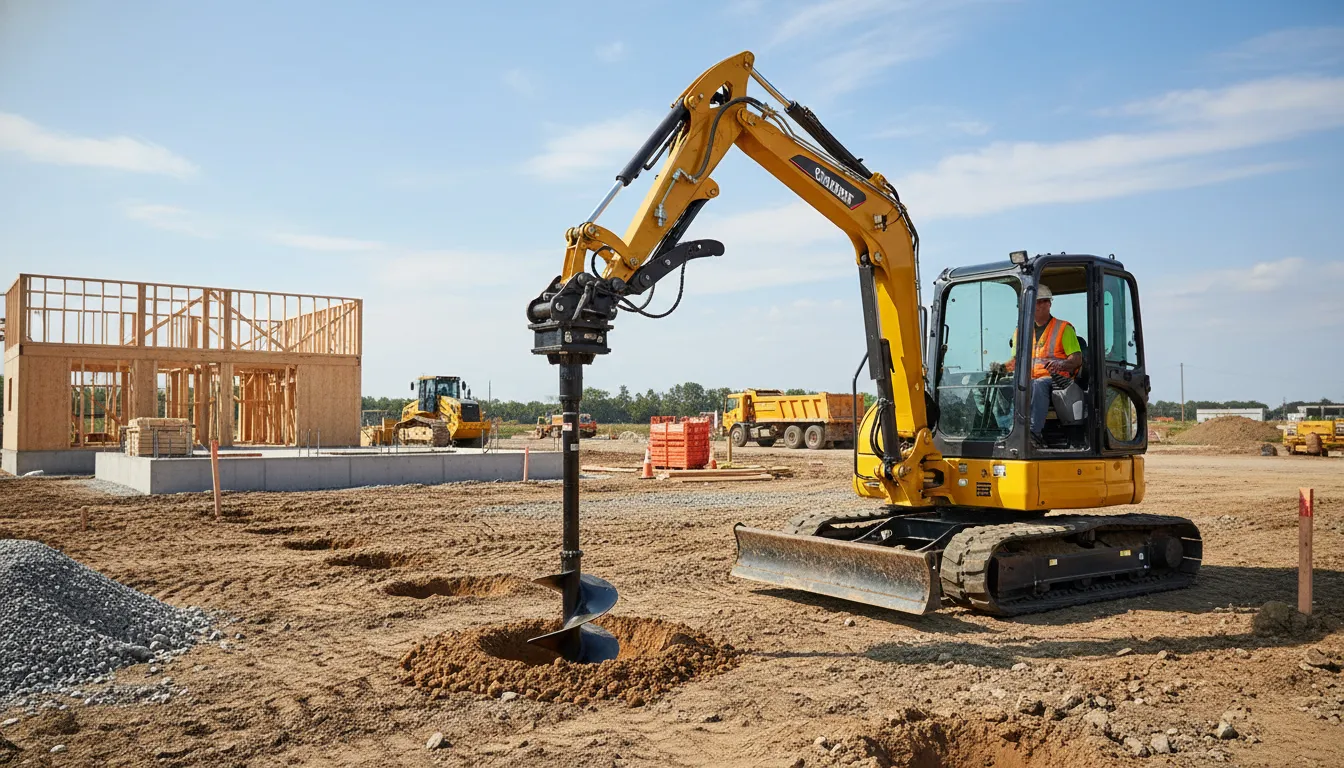
Start with the ground and hole
Dirt bits suit standard earth where their cutting teeth can lift loose soil onto the flighting. Rock bits use bullet teeth for hard, severe ground. Combination bits bridge the gap when a site has changing layers, such as soil mixed with dense or rocky patches.
Diameter also changes the job. A wider bit removes more material on each pass and places more demand on the drive. An academic grounds-care guide notes that soil augers come in several flight diameters. It says larger sizes can prepare holes for trees and shrubs. Review the required hole size before choosing the right auger bit.
| Bit type | Ground fit | Cutting setup | Selection cue |
|---|---|---|---|
| Dirt. | Standard earth and loose soil. | Earth teeth and a soil pilot. | Clean soil with few hard layers. |
| Rock. | Hard or severe ground. | Bullet teeth and a rock pilot. | Dense material that earth teeth cannot cut. |
| Combination. | Mixed or changing ground. | Mixed-ground tooth and pilot setup. | Sites with uncertain soil layers. |
| Specialty. | A narrow material or hole requirement. | Job-specific profile and cutting parts | Work that standard bits do not suit |
How teeth and pilots change the cut
The pilot starts the hole and keeps the bit centered. The teeth then break material at the outer cutting edge. If the pilot cannot enter the ground, the teeth may scrape rather than bite. If the teeth are too light for the material, progress slows and wear rises.
Rock teeth are built to attack hard ground, while dirt teeth focus on cutting and carrying standard earth. A combination bit can reduce bit changes on mixed sites. Still, it is not a substitute for a true rock bit in severe ground. Compare available auger bit types against a test hole or site report.
Why the match affects output and wear
A matched bit spends more of the drive's force cutting useful material. A poor match can make the operator add pressure, repeat passes, or stop to clear the hole. Those delays lower output and can speed wear on teeth, pilots, and flighting.
- Confirm the main soil type and note any rock, fill, clay, or changing layers.
- Choose the smallest diameter that meets the hole requirement.
- Check that the tooth and pilot setup suits the hardest expected layer.
- Inspect replaceable cutting parts before work and as conditions change.
Specialty bits make sense when the material or hole has a clear need that standard designs cannot meet. Confirm the bit connection, rated use, and replaceable parts with the maker. This check helps avoid forcing a bit beyond its intended ground conditions.
Excavator auger compatibility checklist before you buy
An excavator auger attachment must match both the carrier and the work. A drive that fits the mount may still demand too much hydraulic flow. Start with the excavator manual and the auger maker's spec sheet. Confirm each item below before placing an order.
Quick answer: verify machine weight, flow, pressure, mount dimensions, couplers, hose routing, bit diameter, shaft size, drilling depth, and soil type. Treat the carrier, mount, drive, extension, and bit as one system.
Carrier and hydraulic checks
Record the excavator's operating weight, auxiliary hydraulic flow, and auxiliary pressure. Check whether the listed flow is standard or high flow. Then compare all three values with the drive's allowed range. Do not assume that two excavators in the same weight class share the same hydraulic output.
Match the machine weight. Confirm that the drive and mount support the excavator's operating weight. Include the usual bucket, coupler, and other fitted gear.
Verify flow and pressure. Match the drive to the machine's auxiliary flow and relief pressure. Check the values at the attachment circuit, not just the pump rating.
Measure the mount. Note the pin diameter, pin center distance, and space between the mounting ears. Compare those figures with the required bracket or auger drive mounting compatibility details.
Check couplers and hoses. Confirm coupler type, size, hose length, and hose routing. Hoses need enough slack through the full working range without rubbing or pinching.
Size the bit and depth. Choose a bit diameter that suits the hole and drive. Check whether the bit reaches the planned depth or needs an extension.
Match the bit to the ground. Review soil, clay, gravel, and rock conditions across the site. The planned hole size can also guide bit choice for planting or posts.
Bit, depth, and site fit
Ground conditions can change within one jobsite. Standard earth bits suit common soil, while harder ground may call for a different tooth design. Compare options for choosing the right auger bit with what site tests or past digs show.
Check the full drilling setup, not only the bare drive. Add the mount, drive, bit, and any extension when reviewing reach and clearance. Make sure the excavator can hold that setup safely at the planned drilling position.
Final fit confirmation
Send the seller your machine model, serial number, measured pin dimensions, hydraulic flow, and pressure. Also share the needed bit diameter, drilling depth, and ground type. This gives the seller enough detail to confirm the complete setup rather than one part.
Keep the confirmed specifications with the order record. A simple pre-job plan also helps crews use the attachment across suitable tasks. An equipment planning guide from Michigan State University notes that planning excavator use can help maximize hire value.
Compare excavator augers for sale when your shortlist includes the machine class, hydraulic range, bit diameter, and ground type you need.
Compare Excavator Augers for Your Machine
Common applications for excavator augers
Posts, footings, and structural work
An excavator auger attachment turns the machine into a focused drilling tool for jobs spread across a site. Contractors can use it to prepare holes for fence lines, pole barns, deck footings, signs, and retaining systems. The excavator can then move between hole locations without a separate drilling machine.
Fence and structural layouts often call for many holes with a planned diameter and depth. Mark each location first, then keep the bit plumb as drilling starts. Soil augers suit common work such as fence posts and planting, according to this Michigan State University archived guide.
- Fence crews can drill post holes along long property lines.
- Builders can prepare holes for pole barns, decks, and signs.
- Hardscape crews can drill for retaining wall posts or supports.
Landscaping and farm projects
Landscapers can use an auger to open clean planting holes for trees and shrubs. Farmers and property crews can drill for gates, livestock fencing, signposts, and small support structures. Planning several drilling jobs together helps reduce attachment changes and makes better use of time on the machine.
Ground conditions should guide the bit choice. Standard earth bits work best in typical soil, while tougher ground may call for a combination or rock bit. Reviewing available auger bit types can help crews match the cutting head to the planned work.
Restricted and hard-to-reach drilling
The excavator's boom and reach can help when the drilling point sits beyond a ditch, slope, wall, or landscaped edge. This setup lets the operator position the bit from stable ground when site conditions allow. It can also reduce disturbance around planting beds and finished areas.
Reach does not remove the need for careful setup. Crews should confirm overhead room, buried utility locations, ground stability, and a clear swing area before drilling. They should also check that the chosen drive and mount fit the carrier before reviewing excavator auger attachments for the job.
Should you buy or rent an excavator auger?
Renting often fits a one-time fence, planting, or foundation job. Buying tends to fit crews that drill throughout the year. The right choice depends on use frequency, scheduling needs, bit requirements, and who will handle upkeep.
Quick answer: rent when the drilling project is rare, short, and easy to schedule. Buy when repeat work, jobsite timing, specialized bits, and consistent machine fit matter more than the lower upfront cost of a rental.
When renting makes sense
Renting limits the upfront cost and removes the need for long-term storage. It can suit a property owner with one defined project. It also lets a contractor test an excavator auger attachment before adding one to the fleet.
Rental value depends on careful scheduling. An academic groundskeeping guide notes that crews should plan excavator use to maximize hire value. Group the holes, confirm utility markings, and prepare the work area before pickup.
Availability is the main tradeoff. A rental yard may not have the needed drive, mount, bit diameter, or rock bit on the planned date. Extra rental days can also add cost when weather, inspections, or other crews delay drilling.
When buying pays off
Ownership gives a crew control over timing and setup. The attachment is ready for short jobs, urgent repairs, and schedule changes. Buying also lets the owner build a bit inventory for common soil types, hole sizes, and depths.
Crews that drill often can compare excavator auger attachments for sale online without waiting for local rental stock. Product pages make it easier to review drive options, mounts, bits, and package contents before ordering.
The owner must inspect the drive, replace worn teeth, grease service points, and store each part well. Those tasks require time and budget. Still, a cared-for attachment may retain resale value when the fleet changes or drilling work slows.
A practical cost check
Compare more than the purchase price and daily rental rate. Include pickup time, delivery fees, possible rental extensions, maintenance, storage, and downtime. Then estimate how many drilling days the crew expects during the next few seasons.
Bit needs can shift the answer. Buying may be more useful when crews need several diameters or switch between dirt and mixed ground. Review available auger bit types before deciding which inventory makes sense.
Rent when the job is rare, well planned, and easy to match with local stock. Buy when repeat use, fast access, and a ready bit set protect the work schedule.
Mistakes to avoid when shopping for an excavator auger for sale
Hydraulic and mount mismatches
The most costly mistake is choosing a drive before checking the excavator. Match the drive to the machine's hydraulic flow, pressure, weight class, and auxiliary circuit. A drive that receives too little flow may work slowly, while excess flow can strain parts and create heat.
Do not assume an excavator auger attachment fits every machine. Confirm the pin size, pin spacing, mounting width, hose fittings, and coupler style before ordering. Review auger drive mounting compatibility with the seller, using the excavator model and serial number.
Also check the drive output and bit connection. A mount may fit the excavator while the selected bit does not fit the drive. Verify every connection across the machine, mount, drive, extension, and bit.
Oversized bits and wrong teeth
A large bit may look more useful, but greater diameter demands more torque. Buying more width than the job needs can slow drilling and put needless load on the drive. Start with the required hole size. Then confirm that the drive can turn that bit in the expected ground.
Choose teeth for the soil, not for price alone. Standard earth bits suit common soil, while rock-focused bits use teeth made for tougher ground. Compare available auger bit types against clay, loose soil, gravel, or rock at the worksite.
Ground conditions can change across one property. Ask whether teeth and pilots can be replaced in the field, and keep suitable spares close. Worn cutting parts make drilling slower and can raise stress on the rest of the attachment.
Depth planning and wear costs
Many buyers focus on hole width and forget depth. Check the bit's working length and the clearance beneath the excavator before adding an extension. Plan how the crew will attach and remove extensions without placing workers beneath suspended equipment.
An extension adds reach, but it does not fix a poor drive match or the wrong bit. Good planning also helps crews get more value from attachments, according to this Michigan State University archive. Map the expected holes, depths, and ground types before choosing the package.
Finally, budget beyond the purchase price. Teeth, pilots, retaining hardware, hoses, seals, and adapters wear or get damaged over time. Ask which parts are stocked, how they are changed, and whether common service items are easy to source.
Frequently Asked Questions
What is the best auger attachment for a mini excavator?
The best auger attachment for a mini excavator matches the machine's operating weight, hydraulic flow, pressure, mount, and planned soil conditions. There is no universal best model. For context, available mini excavator augers cover several machine classes from 5,000 to 20,000 pounds, according to Rut Manufacturing. Confirm the manufacturer's flow range and mount dimensions before ordering the drive, bit, or package.
Can I use an excavator auger for telehandlers or other machines?
An excavator auger drive may work on a telehandler or another machine only when the drive manufacturer approves that host. The mounting plate, hydraulic flow, pressure, return requirements, and shaft connection must all match. A physical adapter alone does not prove hydraulic compatibility. Check both equipment manuals and obtain written confirmation from the attachment supplier before connecting or operating the auger.
Do I need auger extensions for my excavator?
You need an auger extension when the required hole is deeper than the standard bit can reach while the drive remains safely above ground. Extensions add reach, but they also change handling and may affect the approved setup. The Attachment Company lists 2-inch hex extensions up to 48 inches long. Confirm shaft size, extension rating, and manufacturer limits before use.
Is renting an excavator auger better than buying?
Renting is often practical for a short, one-time project, especially when the required bit type or diameter may change. Buying can make more sense for frequent drilling because the attachment remains available and operators can standardize their setup. Compare rental fees, delivery, downtime, storage, maintenance, and expected job frequency. Whichever route you choose, verify machine and soil compatibility before reserving or purchasing.
Ready to Prepare for Your Next Digging Project?
Selecting an auger before checking your machine and job needs can cause delays, poor results, or an avoidable return. Putting the decision off until work begins leaves little time to compare drive sizes, bit types, mounts, and package options. Starting now gives you time to confirm key details, narrow the choices, and choose an attachment that fits your planned work.
Ready to shop excavator auger attachments? Shop excavator auger attachments now to compare available drives, bits, mounts, and packages before your schedule becomes urgent. After building your shortlist, request compatibility guidance before ordering if your excavator details leave any questions.