

Skid Steer Grader Attachment Guide for Site Prep
Get the Attachment Your Project Needs
Shop proven, work-ready attachments that help you tackle any task with confidence.
LEARN MORERough grading and site prep need precise leveling tools to prevent costly mistakes on job sites. Using the wrong blade ruins your base and wastes fuel. Matching your machine to the correct grading setup solves this problem before you pour any concrete.
Shop the full line of skid steer grader attachments at eSkidSteer. Browse adjustable box graders, beam graders, land planes, and precision laser systems with fast nationwide shipping and transparent "starting at" pricing.
To choose the right tools for your next site prep job, you must first understand how these powerful systems work on the ground. Here is what you need to know about skid steer grader attachment options and what each type delivers on the job site.
What Is a Skid Steer Grader Attachment?
A skid steer grader attachment is a leveling tool that mounts to the front of a compact loader to grade. Smooth, and level soil, gravel, and sand for site preparation. It uses a wide steel moldboard to cut high spots and redistribute material into low areas, acting like a compact motor grader for construction and landscaping work.
A skid steer grader attachment is a heavy duty tool designed to level and grade soil, sand, or gravel. It uses a wide metal moldboard, like a scale version of a large motor grader. When you mount it on your loader, you can prepare roads, pad sites, and parking lots. This attachment gives precise depth control to save you time and dirt.
How grader attachments differ from buckets
Standard loader buckets work well for moving dirt but struggle to keep a flat grade over long runs. A skid steer grader attachment differs because it can push and pull dirt while maintaining a steady height. It rides on support wheels or frame slides that stop the blade from dipping. This design lets you smooth rough areas without leaving high or low spots. Using a grader is much faster than trying to level land with a bucket. It means less hand raking and saves fuel on the job. To see how these tools compare to other gear, check our list of the best skid steer attachments.
Key types of skid steer graders
Grader attachments come in a few common shapes to match your budget and site needs:
- Basic grader blades use a simple moldboard that you can angle to the side. Manual blades require you to exit the cab to change pitch or angle.
- Hydraulic blades let you steer the moldboard from your seat, making it easy to crown a road or slope a bank.
- Box graders and land planes hold dirt inside side plates to fill low spots as you drive, with many using dual blades to cut and fill at the same time.
- Precision laser grading systems use a laser beam to guide hydraulics, with the blade moving automatically to maintain target height within a fraction of an inch.
Precision laser grading systems
For high stakes jobs, you can pair a skid steer grader attachment with a laser system. This setup uses a laser beam to guide the hydraulics. The blade moves up and down on its own to keep the target height, letting you grade a site within a fraction of an inch. Using a laser saves time and cuts down on costly dirt waste.
Exact control is vital for proper water runoff on farm and business sites. Research from the University of Missouri Extension shows that correct grading is needed for proper drainage. Auto grade control systems save time on large building pads. Studies by Ohio State University highlight how laser guidance keeps cuts exact and speeds up site work. These systems make any loader a powerful leveling machine.
How to Choose the Best Skid Steer Grader Attachment for Your Job
Choosing the right skid steer grader attachment depends on matching the tool to your machine specs and the type of work you do most. A grader that works well on a compact skid steer may be too heavy or too wide for a smaller loader. While a light-duty blade will wear out fast on commercial job sites. Here are the key factors to evaluate before you buy.
Match the grader width to your loader
The width of your grader attachment should suit both your skid steer lifting capacity and the width of your tracks or tires. A blade that extends too far past your machine footprint can pull the loader off balance when cutting into hard-packed material. A blade that is too narrow means more passes to cover the same area. As a general rule, choose a grader that is 6 to 12 inches wider than your tire width for adequate coverage without losing stability. For compact skid steers with lower lifting capacities, a lighter land plane or manual box grader in the 6-foot range is a safe starting point. Larger machines can handle 7-foot and 8-foot hydraulic graders that push more material per pass.
Hydraulic flow requirements
Not all skid steer graders need hydraulics, but the ones that do require enough flow from your loader auxiliary system. Check your machine gallons-per-minute (GPM) rating before choosing a hydraulic model. A hydraulic adjustable grader lets you change blade angle, tilt, and depth from the cab without stopping. This control is essential for creating drainage slopes, crowned roads, and precision grades on foundation pads. If your skid steer has low-flow hydraulics (under 15 GPM), consider a manual adjustable box grader instead. Manual models still give you angle and pitch control, but you set it before you start the pass. Many operators start with a manual grader and upgrade to hydraulic once they see the productivity gains.
Grader type comparison at a glance
| Grader Type | Best For | Adjustment | Starting Price | Hydraulics |
|---|---|---|---|---|
| Land Plane | Light driveway maintenance, fine finish | Manual | $1,945 | No |
| Box Scraper | Small farm jobs, moving dirt | Manual | $3,112 | No |
| Economy Box Grader | Gravel road upkeep, mid-size lots | Manual | $4,602 | No |
| Hydraulic Box Grader | Commercial site prep, drainage grading | Hydraulic in-cab | $6,697 | Yes |
| Beam Grader | Edge work near walls and curbs | Hydraulic | $4,797 | Yes |
| Precision Grader | Large pads, sub-inch accuracy | Hydraulic + Laser | $11,314+ | Yes |
Quick-attach compatibility
Every skid steer grader attachment at eSkidSteer uses the standard universal quick-attach mounting plate. This means you can swap between your grader, bucket, pallet forks, and other tools in seconds without leaving the cab. Check that your skid steer coupler system matches the standard plate design. Most modern loaders from Bobcat, Caterpillar, John Deere, Kubota, Case, and Takeuchi use the universal quick-attach system, but some older or European-spec machines may need an adapter. Browse the skid steer couplers collection if you need an adapter for your machine.
Ground pressure and soft-soil grading
When grading on soft ground or freshly filled areas, blade width directly affects machine stability. A wider grader attachment distributes the loader weight and the attachment mass over a larger surface area. This reduces ground pressure and helps prevent the machine from sinking or rutting the surface you are trying to smooth. For finish grading on lawn or topsoil, a wider land plane or box grader with skid shoes gives the best results without digging in too deep.
Loader tire pressure also plays a role in grading accuracy. Under-inflated tires change the ride height of the cutting edge and create inconsistent grade results. Check tire pressure at the start of each day when running precision grade work to maintain consistent blade depth across the job site.
Grading Techniques for Professional Site Prep
Getting the most from your skid steer grader attachment comes down to technique as much as equipment. Whether you are maintaining a gravel driveway or prepping a building pad, the right approach saves time, fuel, and rework. Here are proven techniques used by site prep contractors to deliver consistent grade results.
Browse the full graders collection at eSkidSteer to find the right attachment for your grading technique and job site conditions.
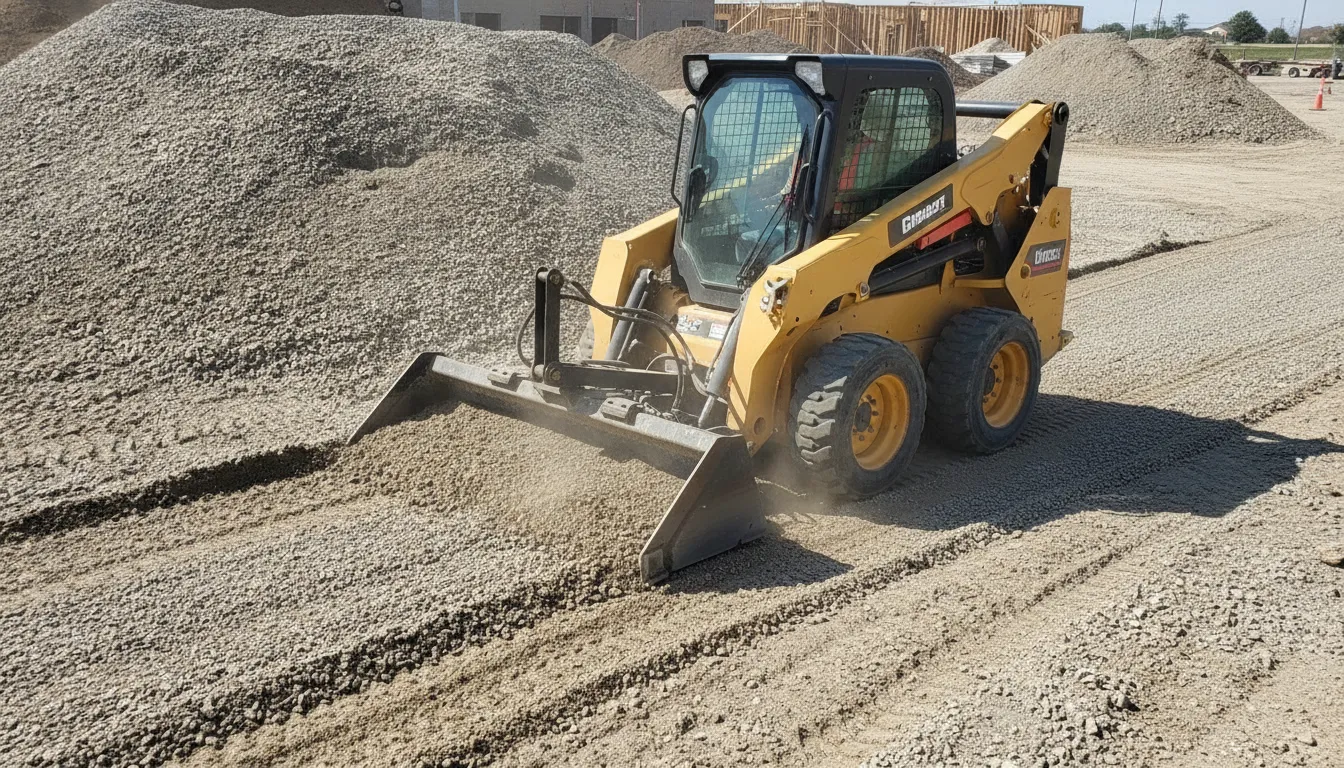
Driveway and road maintenance
Gravel driveways develop ruts and washboarding from traffic and rain. A skid steer grader attachment handles this maintenance faster than any other tool.
- Angle the blade to push material from the edges toward the center.
- Make a shallow pass to knock down the high spots.
- Follow with a leveling pass to spread loose aggregate back into the low areas.
- Set blade tilt for crowned roads to push more material toward the shoulder on each side, leaving the center high for proper drainage.
This shape sheds water and prevents standing puddles that accelerate gravel loss.
Foundation prep for concrete slabs
Pouring concrete over an uneven base leads to cracking, settling, and callbacks. Use your grader attachment to establish a consistent subgrade before the forming crew arrives. Start with rough grading passes to move large amounts of material into the right elevation range. Then switch to finish passes that remove no more than one inch per pass. Laser-guided grading systems take the guesswork out of foundation prep by automating blade height control to within a quarter inch of target elevation. For smaller residential slabs. Multiple shallow passes with a manually adjusted box grader still produce excellent results when you take your time and check grade frequently with a transit or string line.
Fine grading with multiple shallow passes
The single most important rule of precision grading is this: do not try to cut or fill more than one to two inches per pass. Attempting to move large volumes in one pass causes the blade to dig in, the machine to bog down, and the finished surface to develop washboard waves. Instead, make several passes at increasing depth:
- First pass: skims the high spots.
- Second pass: redistributes material into low areas.
- Third and fourth passes: refine the surface to a smooth, consistent plane.
This approach also reduces strain on your loader hydraulics and extends the life of your cutting edge.
Maneuverability benefits over motor graders
A motor grader is purpose-built for grading roads, but it cannot work in tight spaces. A skid steer with a grader attachment fits through standard gates, works around buildings, and grades in confined residential lots where a motor grader simply will not fit. The skid steer's zero-turn capability lets you make tight maneuvers at the end of each pass without three-point turns. For small commercial sites, subdivisions, and farm roads, the skid steer grader attachment delivers motor-grader quality with much better access. Pair your grader with a quality set of skid steer buckets to handle material moving and fine grading on the same machine without switching equipment.
Creating drainage slopes
Water management is critical on any graded site. Set your grader blade to a slight tilt on each pass to create a consistent slope away from structures. Check the angle with a digital level or laser receiver every 50 feet to ensure the slope stays consistent. For building pads, target a minimum slope of two percent (one quarter inch per foot) to direct water away from the foundation. For large commercial sites, work from the high point down, angling each pass to push water toward planned drainage swales or retention areas.
What Is the Cost of a Skid Steer Grader Attachment?
Buying a skid steer grader attachment is a smart move for your team, but you must know how much they cost before you buy. Prices vary a lot based on size and features. Simple land planes and scrapers are the cheapest options, while professional hydraulic graders cost the most. Routine grading of gravel surfaces helps manage water runoff and prevents road failures, as shown by the U.S. Environmental Protection Agency.
Entry level land planes and box scrapers
For basic leveling jobs, you do not need to spend a fortune. Land planes and box scrapers are great entry tools that work well for maintaining driveways and small dirt paths. Land planes from eSkidSteer start at about $1,945. These tools have simple dual blades that shave off high spots and fill in low areas as you drive. If you need to move more dirt, a box scraper is a good choice. Box scrapers start at about $3,112 and have side plates to hold soil in place. They help you drag dirt and spread it out. Because they do not have complex parts, these tools are easy to use and best for small farm chores.
Mid range box graders and beam systems
If you do road work often, you will want more control. Box graders and beam systems offer better grading with front and rear blades to level dirt. The Economy Roadrunner box grader starts at $4,602. It is a sturdy unit that can grade tough gravel roads with ease. For more precision, you can buy adjustable box graders. A manual adjustable box grader starts at $6,013, while a hydraulic model starts at $6,697. You can also get a Skeer Beam grader starting at $4,797. This smart design helps you grade next to walls and curbs.
Professional graders for precision work
Large projects need tools that can handle precise grade specs. Built for this task, professional-grade skid steer attachments can cut and spread dirt down to the fraction of an inch. The Skeer Pro grader starts at $11,314. For heavy commercial work, the Skeer Pro Plus starts at $15,332 and uses an advanced design to work fast. Prices for these tools vary based on width and features. Hydraulic control blocks add cost but let you work much faster. Browse our full selection of skid steer grader attachments online to find the best fit. Matching your tool to your equipment will save you time and money.
How to Maintain Your Skid Steer Grader Attachment
A well-maintained skid steer grader attachment delivers consistent grade results and lasts for years of heavy use. Neglecting basic maintenance leads to uneven grading, hydraulic leaks, and premature blade wear. Follow this routine to keep your attachment in top condition across every job site.
Inspect the cutting edge regularly
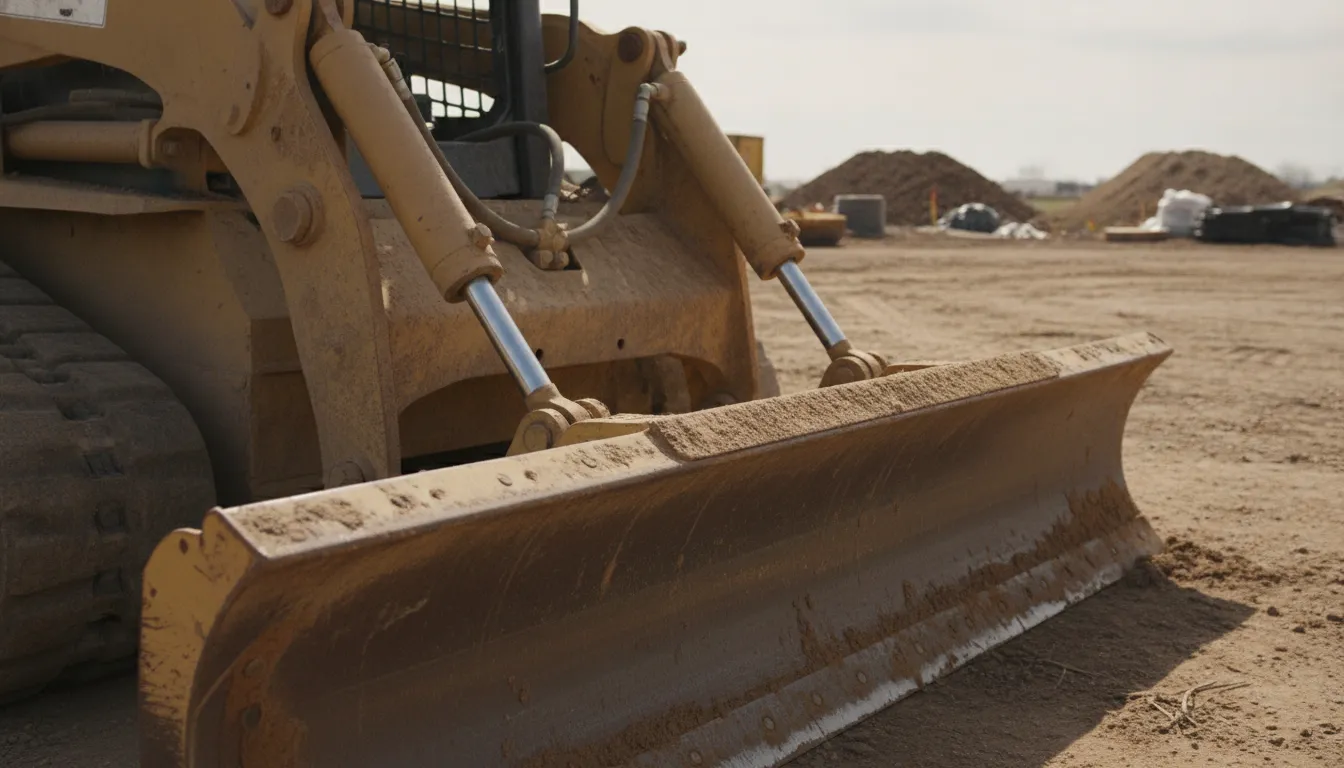
The cutting edge takes the most abuse during grading, especially when working on gravel, asphalt, or compacted soil. Check the edge before and after each full workday. Look for uneven wear, chipped sections, or thinning that reduces cutting effectiveness. Most grader attachments use replaceable hardened steel cutting edges that bolt onto the moldboard. When the edge wears down to half its original thickness or develops a visible curve, replace it with a new edge. Running a dull or uneven cutting edge forces the blade to work harder and produces an inconsistent grade finish.
Check hydraulic lines and cylinders
Hydraulic graders rely on clean fluid and sealed cylinders to maintain blade position under load. Inspect all hydraulic hoses for cracks, chafing, or bulges that signal impending failure. Check cylinder seals for external leaks at the rod end and barrel end. A slow hydraulic leak not only reduces blade holding power but also contaminates the job site with oil. Wipe the cylinder rods clean after each use to prevent dirt from scoring the seal surface. If you see foaming in the hydraulic return line or inconsistent blade drift, the system may need bleeding or a seal replacement.
Grease pivot points after every shift
Grader attachments have multiple pivot points where the blade frame connects to the mounting plate and tilt mechanism. Each of these joints needs clean grease to prevent metal-on-metal wear that creates slop in the blade control. Use a hand grease gun to apply lithium-based grease to every zerk fitting until fresh grease pushes out the old material. Pay special attention to the main pivot pins and the linkage arms on hydraulic tilt mechanisms. A well-greased grader responds instantly to control inputs and holds its position without drifting.
Clean the moldboard and scarifier teeth
Wet clay and sticky soil build up on the moldboard face and between scarifier teeth during grading. This buildup adds weight to the attachment and prevents the blade from cutting cleanly through fresh material. After each use, especially when working with wet soil, scrape the moldboard clean with a flat shovel or pressure washer. For attachments with scarifier teeth, remove packed dirt between each tooth to keep the ripping action effective. Store the attachment on a dry surface or pallet to prevent the moldboard from sitting in moisture that accelerates rust.
Modular upgrades for changing soil conditions
Many grader attachments accept modular accessories that adapt the tool to different site conditions. Replaceable tooth bars, scarifier shanks, and bolt-on side wings let you customize your grader for rocky soil, hard-packed clay, or loose sand without buying a whole new attachment. When you switch to a different soil type, inspect the mounting hardware for the modular components and torque all bolts to the manufacturer spec. Loose bolts cause vibration that accelerates wear on both the attachment and your skid steer quick-attach plate. For tough compacted ground, use a soil ripper attachment first to break up the hardpan, then follow with the grader for leveling in fewer passes.
Frequently Asked Questions About Skid Steer Grader Attachments
What is a skid steer grader attachment?
A skid steer grader attachment is a leveling tool that mounts to the front of a skid steer loader to grade. Smooth, and level soil, gravel, sand, and other materials. It uses a wide steel moldboard to cut high spots and redistribute material into low areas, acting like a compact motor grader for site preparation work.
Can you grade with a skid steer?
Yes. A skid steer equipped with a grader attachment can perform precise grading and leveling work on driveways, building pads, roads, and landscaping sites. The combination of a skid steer's maneuverability and a grader attachment moldboard control makes it a capable grading tool for residential, commercial, and agricultural applications.
What is the best skid steer attachment for grading?
The best attachment depends on your work. For general site prep and driveway maintenance, a hydraulic adjustable box grader gives the best control and speed. For fine finish grading on building pads, a laser-guided precision grader delivers sub-inch accuracy. For light-duty leveling on soft ground, a land plane is cost-effective and easy to use.
How much does a skid steer grader attachment cost?
Skid steer grader attachment prices vary by type and features. Entry-level land planes start around $1,945. Manual and hydraulic box graders range from $4,600 to $7,500. Professional-grade precision graders from Skeer range from $4,800 for the Beam model to over $15,000 for the Pro Plus with advanced hydraulic controls.
What maintenance is required for skid steer grading attachments?
Regular maintenance includes inspecting the cutting edge for wear, checking hydraulic lines for leaks, greasing all pivot points after each shift. Cleaning the moldboard and scarifier teeth after use, and replacing the hardened steel cutting edge when it wears to half its original thickness. Pair your grader with quality skid steer grapples and auger drives to expand your machine's job site capability.
Ready to Upgrade Your Site Prep Equipment?
Shop the complete skid steer grader attachment collection at eSkidSteer. From entry-level land planes to professional-grade Skeer precision graders, we carry the tools you need for every grading job. Get your equipment online with fast nationwide shipping, easy financing, and transparent "starting at" pricing backed by real equipment expertise.
Compare models, widths, and hydraulic configurations to find the perfect grader for your skid steer. Browse graders now and get your machine set up for professional-grade site prep results.