

- Skid Steer
- Skid Steer
- Go to Skid Steer
- 3 Point Adapters
- Accessories
- Attachment Racks
- Augers
- Backhoes
- Bale Handlers
- Bale Spears
- Booms & Jibs
- Box Grader
- Box Scraper
- Breakers
- Brooms & Sweepers
- Brush Cutters
- Buckets
- Cold Planers
- Concrete Equipment
- Concrete Mixers
- Concrete Pumps
- Concrete Saw
- Dozer Blades
- Electrical Accessories
- Feed Pusher
- Fence Installer
- Graders
- Grapple Rake
- Grapples
- Hoppers
- Land Planes
- Landscape Rake
- Log Splitters
- Mulchers
- Pallet Forks
- Paver Attachment
- Planers & Graders
- Post & Tree Pullers
- Post Drivers
- Power Rakes
- Replacement Doors & Windows
- Rotary Tillers
- Rotating Attachment
- Salt Spreaders
- Snow Blowers
- Snow Plows
- Snow Pushers
- Sod Rollers
- Storage
- Stump Grinders
- Trailer Movers
- Tree Puller
- Tree Shears
- Tree Spades
- Trenchers
- Vibratory Rollers
- Work Platforms
- Mini Skid Steer
- Mini Skid Steer
- Go to Mini Skid Steer
- Accessories
- Augers
- Backhoes
- Brooms & Sweepers
- Brush Cutters
- Buckets
- Concrete Breakers
- Dozer Blades
- Electrical Accessories
- Grapple Rake
- Grapples
- Hitches
- Land Planes
- Log Grapples
- Mounting Plates
- Pallet Forks
- Rotary Tillers
- Snow Attachments
- Sod Rollers
- Stump Grinders
- Trenchers
- Excavator
- Excavator
- Go to Excavator
- Accessories
- Adapters
- Augers
- Breaker Hammers
- Brush Cutters
- Buckets
- Cold Planers
- Electrical Accessories
- Grading Beam
- Grapples
- Hydraulic Thumb
- Log Splitters
- Mulchers
- Part & Accessories
- Plate Compactors
- Post Drivers
- Quick Couplers
- Replacement Doors & Windows
- Rigid Thumb
- Ripper
- Root Rakes
- Screening Buckets
- Tree Grubbers
- Telehandler
- Tractor
- Shop By Brand
- Shop By Brand
- Go to Shop By Brand
- Amulet
- Anbo
- Bradco
- Cardinal Canvas Products
- Depco
- Digga
- Equipment Lock
- EZ SPOT UR
- FFC
- Haugen Attachments
- Ideal Rockaway
- Maxx Attachments
- McLaren Industries
- Paladin Heavy
- Pengo Attachments
- Quality Chain
- Roadrunner
- Shields
- Skeer
- Skid Steer Genius
- Stanley
- Star Industries
- Strike Force
- The Silt Fence Plow
- Top Dog Attachments
- Ventures Equipment
- WAIN ROY
![]()
- Blogs

Sale
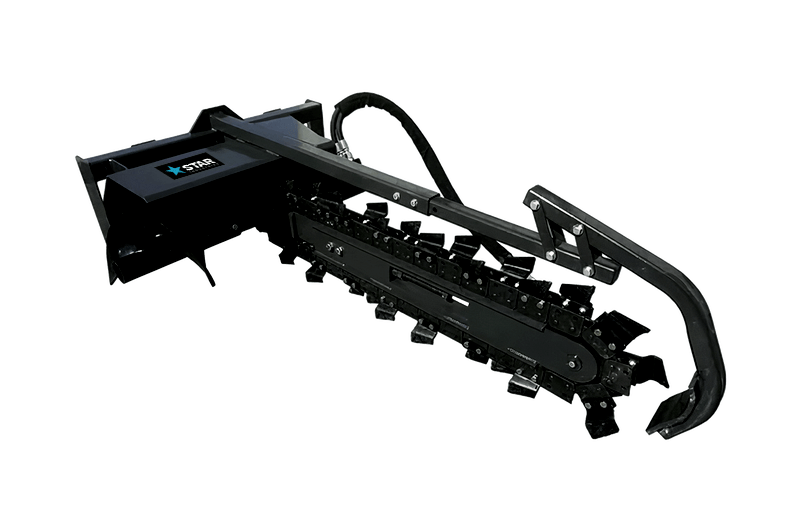
Skid-Steer Trencher - Star Industries
- $10,369.99
$11,405.99- $10,369.99
- Unit price
- / per
Subtotal:
$10,369.99
Couldn't load pickup availability

📘 Overview
The Star Industries Model 131-48 Skid-Steer Trencher provides 48" trenching depth in three cutting variants: 131-48C (chain trencher for standard soil), 131-48D (disc trencher for sandy/loose soil), and 131-48R (rock trencher for hard material). SSQA mount. Hydraulically driven. 5-year factory guarantee. USA since 1981.
⚙️ Key Features
- 131-48C: Chain trencher — standard soil and clay
- 131-48D: Disc trencher — sandy and loose soil
- 131-48R: Rock trencher — hard material and rocky soil
- 48" maximum trench depth
- SSQA hydraulic | 5-year factory guarantee | USA since 1981
🔑 Benefits
- Three cutting variants cover all ground conditions from loose sand to solid rock
- 48" depth accommodates standard utility and irrigation line burial depths
- SSQA mount enables quick swap between trencher and other skid steer attachments
- Hydraulic drive provides consistent cutting power regardless of ground resistance
📊 Specifications
| Specification | Value | |
|---|---|---|
| 131-48C | Chain | Standard soil, clay, dirt |
| 131-48D | Disc | Sandy, loose, and granular soil |
| 131-48R | Rock | Hard rock, compacted caliche, frozen ground |
🔗 Attachment Compatibility
SSQA. Requires aux hydraulic drive circuits. Confirm machine aux GPM meets trencher requirements. Select correct cutting variant for soil conditions.
🚜 Machine Compatibility
Compatible with skid steer loaders and compact track loaders with a Universal Quick Attach (SSQA) system:
| Bobcat | Caterpillar | John Deere | Case |
| New Holland | Takeuchi | Kubota | Gehl |
Compatibility determined by mount type — confirm your machine's quick attach configuration before ordering.
❓ FAQs
|
Q: Which variant should I choose — C, D, or R?
131-48C (chain) for most standard soil conditions including clay and compacted dirt. 131-48D (disc) for sandy, loose, or granular soil where chain can wrap or clog. 131-48R (rock) for hard rock, caliche, shale, or frozen ground conditions. When in doubt about ground conditions, C (chain) handles the widest range. |
|
Q: What hydraulic flow does the trencher require?
Contact eSkidSteer at 866-757-8337 for the specific GPM and pressure requirements for the 131-48 models. |
|
Q: Can the trencher be used to cut through existing roots?
The chain trencher (131-48C) can cut through roots up to a certain diameter. Large roots can jam a chain trencher — clear major root systems before trenching or contact eSkidSteer for root-cutting capability guidance. |
|
Q: What trench width does each model produce?
Trench width is determined by the chain or disc width. Contact eSkidSteer at 866-757-8337 for trench width specifications. |
|
Q: How fast can I trench?
Ground speed depends on soil hardness, rock content, and machine hydraulic flow. In ideal conditions (loose sandy soil) the disc trencher can achieve higher speeds. In rock and clay, significantly slower speeds are required for quality trench walls and to protect the cutting system. |
📥 Downloads
🎥 Videos
Related Products
Recently Viewed Products
- Choosing a selection results in a full page refresh.